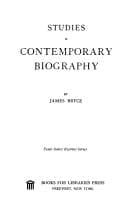
Studies in Contemporary BiographyBryce, James Bryce, Viscount
History
Studies in Contemporary Biography
Bryce, James Bryce, Viscount
Great Britain -- Biography
That he was right in 1876-78 in the view he took of the line of
conduct England should adopt towards the Turks has been now virtually
admitted even by his opponents. That he was also right in 1896, when
urging action to protect the Eastern Christians, will probably be
admitted ten years hence, when the facts of the case and the nature of
the opportunity that existed for taking prompt action without the risk
of a European war have become better known. In both cases it was not
merely religious sympathy, but also a far-sighted view of policy that
governed his judgment. He held that the faults of Turkish rule are
incurable, and that the Powers of Western and Central Europe ought to
aim at protecting the subject nationalities and by degrees extending
self-government to them, so that they may grow into states, and in
time be able to restore prosperity to regions ruined by long
misgovernment, while constituting an effective barrier to the advance
of Russia. The jealousies of the Powers throw obstacles in the way of
this policy, but it is a safe policy for England, and offers the best
hope for the peoples of the East.
The facts just noted prove that he possessed and exerted a capacity
for initiative in foreign as well as in domestic affairs. In the
Neapolitan case, in the _Alabama_ case, in the Bulgarian case, he
acted from his own convictions, with no previous suggestion of
encouragement from his party; and in the last-mentioned instance he
took a course which did not at the moment promise any political gain,
and which seemed to the English political world so novel and even
startling that no ordinary statesman would have ventured on it.
His courage was indeed one of the most striking parts of the man.[68]
It was not the rashness of an impetuous nature, for, impetuous as he
was when stirred by some sudden excitement, he showed an Ulyssean
caution whenever he took a deliberate survey of the conditions that
surrounded him. It was the proud self-confidence of a strong
character, which was willing to risk fame and fortune in pursuing a
course it had once resolved upon; a character which had faith in its
own conclusions, and in the success of a cause consecrated by
principle; a character which obstacles did not affright, but rather
roused to a higher combative energy. Few English statesmen have done
anything so bold as was Mr. Gladstone's declaration for Irish Home
Rule in 1886. He took not only his political power but the fame and
credit of his whole past life in his hand when he set out on this new
journey at seventy-seven years of age; for it was quite possible that
the great bulk of his party might refuse to follow him, and he be left
exposed to derision as the chief of an insignificant group. As it
happened, the bulk of the party did follow him, though many of the
most influential refused to do so. But neither he nor any one else
could have foretold this when his intentions were first announced.
Public-domain text, read in full here on John Shaqi.
Reviews
Reviews
No reviews yet
Be the first to share your thoughts on this work.
Elsewhere in the archive
Join the Discussion
Join the discussion
Sign in to leave a comment or review.
Sign InorCreate an account