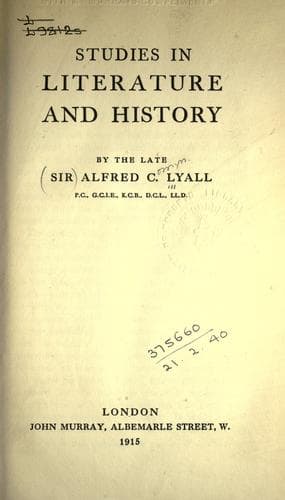
Studies in Literature and HistoryLyall, Alfred C., Sir
Religion
Studies in Literature and History
Lyall, Alfred C., Sir
English literature; History; Literature; Religion; Utilitarianism
On the whole, whether we assume that the object of a novel is to
illustrate history, or to present a faithful reflection of life and
manners, or to render strenuous action dramatically yet not
improbably--by whatever standard we measure Mr. Crawford's book, it
cannot be awarded a high place on the list of Indian fiction. But we
have run over this list so rapidly, touching only upon typical
examples, that we are now among the latest writers of the present
day; and we may take _Helen Treveryan_ (1892) as a very favourable
specimen of their productions. Comparing it with earlier novels, we
may remark, in the first place, that there is no great variety of plot
or treatment, Anglo-Indian society being everywhere, and at most
times, very much the same, except so far as closer intercourse with
Europe softens down its roughness, materially and morally, increases
the feminine element, and assimilates its outer form to the English
model. _Helen Treveryan_, whose author is a very distinguished member
of the Indian Civil Service, is, like all other novels of the kind,
the narrative of the adventures, in love and war, of a young English
military officer in India. The characters are evidently drawn from
life; the main incidents belong to very recent Indian history; the
description of society in an up-country station, with which the
movement of the drama begins, is an exact and humorous photograph. A
tiger hunt is done better, with more knowledge of the business, than a
similar episode in Mr. Crawford's novel; and the passionate love
between Guy Langley and Helen Treveryan is well painted in bright
colours to intensify the gloom and pathos of Langley's death in
battle.
As Chesney went to the sepoy mutiny for his scenes of tragedy and
heroism, so Sir Mortimer Durand (we believe that the original
pseudonym has been dropped) takes them from the second Afghan War,
having been at Kabul with General Roberts in the midst of hard
fighting, where he first placed his foot on the ladder which has led
him upward to high places and unusual distinction. In the chapters
describing the march upon Kabul, its occupation, the rising of the
tribes, and their attack upon the British army beleaguered in the
Sherpur entrenchments, we have simply a memoir of actual events,
written with truth, spirit, and with the pictorial skill of an artist
who understands the value and proportion of romantic details. The
English commanders, the Afghan sirdars, and several other well-known
folk are mentioned by name; the skirmishes and perilous situations are
described just as they really occurred. No book could better serve the
purpose of a home-keeping Englishman who might desire to see as in a
moving photograph what was going on in the British camp before Kabul
during the perilous winter of 1879-80, to hear the camp-talk, and to
realise the nature and methods of Afghan fighting.
Public-domain text, read in full here on John Shaqi.
Reviews
Reviews
No reviews yet
Be the first to share your thoughts on this work.
Elsewhere in the archive
Join the Discussion
Join the discussion
Sign in to leave a comment or review.
Sign InorCreate an account