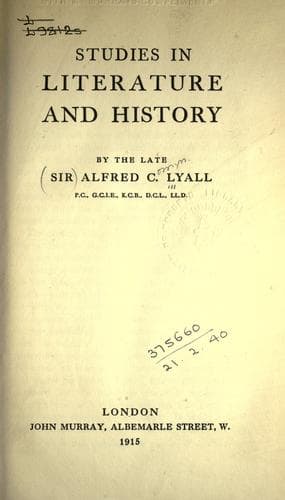
Studies in Literature and HistoryLyall, Alfred C., Sir
Religion
Studies in Literature and History
Lyall, Alfred C., Sir
English literature; History; Literature; Religion; Utilitarianism
Is such minute matter-of-fact copying a virtue in the novelist? or is
it not rather a defect arising out of a misunderstanding of the
principles of his art? In our opinion the business of the novelist,
even when he chooses an historical subject, is not to reproduce as
many exact details as he can pick out of memoirs, official reports,
and histories, but, on the contrary, to avoid making up his story out
of a string of extracts and personal reminiscences, or at any rate to
use his skill rather for disguising than for disclosing the precise
verbal accuracy of his borrowed material. What would be thought of a
naval romance that adopted, word for word, the authentic account of
Nelson's death, or of a military novel that seasoned a full and
particular account of Waterloo with a few imaginary characters and
incidents? Any one who has observed how two fine writers, Thackeray
and Stendhal, have brought that famous battle into the plot of their
masterpieces (_Vanity Fair_ and _La Chartreuse de Parme_), will have
noticed that they carefully avoid the crude and undisguised employment
of detail, either in words or incidents; they allow fiction to
interfere very constantly with fact in all petty matters of this sort;
their art consists, not in historical accuracy, but in verisimilitude;
they discard authentic phrases and incidents; they do not aim at
precision, but at dramatic probabilities. But Mrs. Steel does not only
draw too copiously, for a novelist, upon history; she also undertakes
to pass authoritative judgments upon disputable questions of fact and
situation, with which fiction, we submit, has no concern. She very
plainly intimates that nothing but culpable inaction and want of
energy prevented instant pursuit by a force from Meerut of the
mutineers who made a forced march upon Delhi on the night of May 10,
and whose arrival produced the insurrection in that city.
'Delhi lay,' she says, 'but thirty miles distant on a broad white
road, and there were horses galore and men ready to ride them--men
like Captain Rosser, of the Carabineers, who pleaded for a
squadron, a field battery, a troop, or a gun--anything with which
to dash down the road and cut off that retreat to Delhi.'
To argue the point in this review would be to fall into the very error
on which we desire to lay stress, of attempting to deal with serious
history in a light, literary way. We shall therefore be content with
reminding our readers that Lord Roberts, who is perhaps the very best
living authority on the subject, has come to the conclusion, after a
careful survey of the circumstances, that the refusal of the Meerut
commanders to pursue the mutineers was justifiable.
Public-domain text, read in full here on John Shaqi.
Reviews
Reviews
No reviews yet
Be the first to share your thoughts on this work.
Elsewhere in the archive
Join the Discussion
Join the discussion
Sign in to leave a comment or review.
Sign InorCreate an account