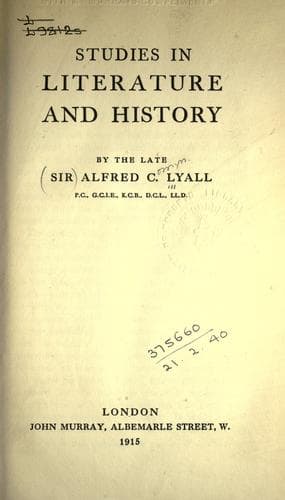
Studies in Literature and HistoryLyall, Alfred C., Sir
Religion
Studies in Literature and History
Lyall, Alfred C., Sir
English literature; History; Literature; Religion; Utilitarianism
A similar fate, it may here be noticed, has overtaken, or awaits, the
heroic songs of the Afghans; for Darmesteter tells us that as the oral
tradition becomes written it falls into the net of translation and
paraphrase, it is absorbed into the elegant literature of Persia,
Arabia, and Hindustan, it becomes theological and romanesque. And
another dangerous enemy has now appeared in the shape of the
Anglo-Indian schools which follow and fix the English dominion; for
the primitive folklore has no more chance against systematic education
than the wild fighting men have against drilled and disciplined
soldiers. In Europe the Sagas of Iceland, which lay furthest from the
civilising influences, had the luck of preserving the true elements of
heroic narrative; and the Anglo-Saxon poem of Beowulf, though it falls
far short of the epic, has a certain Homeric flavour. The chief is the
'folces-hyrde,' his people's shepherd; and we have Beowulf, like
Hector,[20] desiring that after his death a mound may be raised at the
headland which juts out into the sea, 'that seafaring men may
afterward call it Beowulf's Mound, they who drive from far their
roaring vessels over the mists of the flood.'[21]
Let us turn now to the romantic poetry of England, which for some
centuries ruled all our imaginative literature, and annexed, so to
speak, almost the whole field of battles, adventures, and energetic
activity generally. The subjects are much the same: the gallantry of
men, the beauty, virtues, and frailties of women: but the writers have
got a loose uncertain grip upon the actualities of life; they wander
away into fanciful stories of noble knights, distressed damsels, and
marvellous feats of chivalry--in short they are _romancing_. They care
little whether the details accord with natural fact--whether, for
instance, the account of a fight is incredible to any one who knows
what a battle really is; the heroes are chivalrous knight-errants,
noble, pious, devoted to their lady loves; but they are not
hard-headed, hard-fisted men like Ulysses, David, or some old
Icelandic sea-rover. The true heroic spirit shoots up occasionally,
nevertheless the prevailing idea of the romance-writer is to tell a
wondrous tale of love and adventure, in which he lets his fancy run
riot, rather enjoying than avoiding magnificent improbabilities.
Undoubtedly the beautiful mystic romance of the Morte d'Arthur does
light up at the end with a true flash of heroic poetry, in the famous
lamentation over Lancelot, when he is found at last dead in the
hermitage: but in this passage the elegiac strain rises far above the
ordinary level of romantic composers. Meanwhile, as the English nation
at home settled down into peaceful habits under the strong organising
pressure of Church and State, and arms gave way to laws, the hero's
occupation disappeared from our everyday society, and the heroic
tradition decayed out of imaginative literature, which was often
Public-domain text, read in full here on John Shaqi.
Reviews
Reviews
No reviews yet
Be the first to share your thoughts on this work.
Elsewhere in the archive
Join the Discussion
Join the discussion
Sign in to leave a comment or review.
Sign InorCreate an account