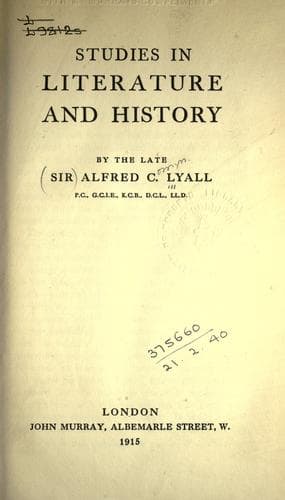
Studies in Literature and HistoryLyall, Alfred C., Sir
Religion
Studies in Literature and History
Lyall, Alfred C., Sir
English literature; History; Literature; Religion; Utilitarianism
An unsophisticated audience would have laughed outright at such a
comical performance. And we can see how Scott, as a poet of the
battlefield, had become possessed with the idea that the grand style
must be a lofty strain, something magnificently unusual, by his two
poems upon Waterloo, which are fine failures; though we may admit the
impossibility of making a heroic poem out of a battle that has just
been minutely described in newspapers. On the other hand, his prose
novels afford us a remarkable example of the two styles contrasted.
When he wrote of the middle ages, as in _Ivanhoe_, _The Talisman_, and
others, he was a pure romancer; whereas in his Tales of Scotland in
the seventeenth and eighteenth centuries, in the _Legend of Montrose_,
_Old Mortality_, _The Bride of Lammermoor_, there are two or three
rapid sketches of sharp fighting which are true and spirited, full of
vivacity and character. On this ground he trod firmly, knowing the
country, the times, and the people of Scotland: while the petty
skirmishes at Drumclog or Bothwell Brig were easier to manage
artistically than a great battle. Poetry, indeed, like painting, can
do nothing on a vast scale, cannot manage masses of men; and moreover
it fails to deal effectively with a state of war in which mechanical
skill and the tactical movement of large bodies of troops win the day.
There may be as much personal heroism as ever, but it is lost in the
multitude. Nevertheless sea-fighting, where separate ships may
encounter and grapple like two mortal foes, with the deep water
around and beneath them, gives heroism a better chance; and the
mariner is always a poetic figure. So Thomas Campbell did rise very
nearly to the heroic level in his poem on the battle of the Baltic,
written when the true story of Nelson's famous exploit was still
fresh; we have a clear and forcible impression of the British ships
moving silently to the attack; and the closing lines touch the ancient
ever-living feeling of gratitude to Captain Riou and his brave
comrades, 'so tried and yet so true,' who fell in the great victory.
Public-domain text, read in full here on John Shaqi.
Reviews
Reviews
No reviews yet
Be the first to share your thoughts on this work.
Elsewhere in the archive
Join the Discussion
Join the discussion
Sign in to leave a comment or review.
Sign InorCreate an account