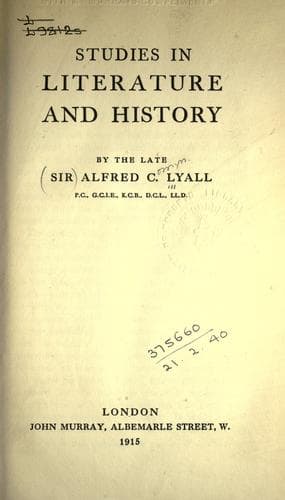
Studies in Literature and HistoryLyall, Alfred C., Sir
Religion
Studies in Literature and History
Lyall, Alfred C., Sir
English literature; History; Literature; Religion; Utilitarianism
'But let me put an end unto my theme,
There was an end of Ismail, hapless town,
Far flashed her burning towers o'er Danube's stream,
And redly ran his blushing waters down.
The horrid warwhoop and the shriller scream
Rose still; but fainter were the thunders grown;
Of forty thousand that had manned the wall
Some hundreds breathed, the rest were silent all.'
'A versified paraphrase,' it may be said, 'of sober history,' yet
withal very different from the most animated prose, which must be kept
at a lower temperature of intense expression. If we turn to quieter
scenes--which are called picturesque because the artist, like a
painter, has selected the right subject and point of view, and has
grouped his details with exquisite skill--we may take the stanzas
describing the return of the pirate Lambro to his Greek island--
'He saw his white walls shining in the sun,
His garden trees all shadowy and green'--
as a fine example of pure objective writing, which lays out the whole
scene truthfully, with the direct vision of one who has seen it. One
does not find here the suggestive intimations, the wide imaginative
horizon of higher poetry; there are no musical blendings of sound and
sense, as in such lines as Tennyson's
'By the long wash of Australasian seas.'
Yet in these passages Byron has after his own fashion served Nature
faithfully, and he has preserved to us some masterly sketches of life
and manners that have long since disappeared. The Greek islands have
since fallen under the dominion of European uniformity; the costume of
the people, the form of their government, are shabby imitations of
Western models. But the cloudless sky, the sun slowly sinking behind
Morea's hills, the sea on whose azure brow Time writes no wrinkle, and
the marbled steep of Sunium, are still unchanged; and the peaceful
tourist in these waters will see at once that Byron was a true workman
in line and colour, and will feel the intellectual pleasure that comes
from accurate yet artistic interpretation of natural beauties.
Public-domain text, read in full here on John Shaqi.
Reviews
Reviews
No reviews yet
Be the first to share your thoughts on this work.
Elsewhere in the archive
Join the Discussion
Join the discussion
Sign in to leave a comment or review.
Sign InorCreate an account