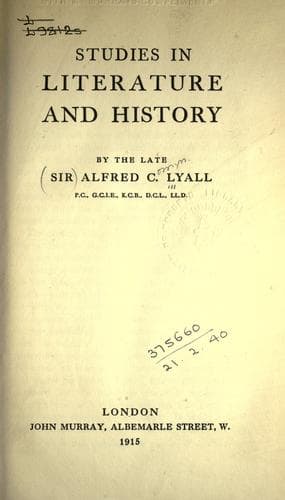
Studies in Literature and HistoryLyall, Alfred C., Sir
Religion
Studies in Literature and History
Lyall, Alfred C., Sir
English literature; History; Literature; Religion; Utilitarianism
Russia, but also for Morocco.'
Mr. Stephen has no difficulty in exposing the shortcomings and
inadequacy of these doctrines. But he is writing the history of
certain political ideas; so his main object is to show how such ideas
are formed, the course they have followed, and their influence upon
thought and action up to the present day. To trace the links and
continuity of ideas is to analyse their elements, and to show the
impress that they received from external circumstance, permanent or
temporary; it is an important method in the science of politics. Upon
the empiricism of English philosophy in the eighteenth century Bentham
constructed a Theory of Morals that purported to rest exclusively on
facts ascertained and verifiable, with happiness as our being's end
and aim, with pain and pleasure as the ultimate principles of conduct;
and upon this foundation he proceeded to build up his system of
politics and legislation. Any attempt to derive morality from other
sources, or to measure it by other standards, he denounced as
arbitrary and misleading; he threw aside metaphysics, and therefore
theology, as illusory. The exclusive appeal to experience, to plain
reasoning from the evidence of our senses, from actual observation of
human propensities, was sufficient for his purposes, and tallied with
his designs as a practical reformer. In these views he was a disciple
of Hume, whose influence has surreptitiously percolated all modern
thought, and his unintentional allies were the teachers of Natural
religion, with Paley as its principal exponent. Having thus defined
and explained the basis of ethical philosophy, the Utilitarian has to
build up the superstructure of legal ordinance; and he is at once
confronted by the difficult problem of distinguishing the sphere of
ethics from the province of law. Upon this vital question Mr. Stephen,
as an expert in ethics, gives a dissertation that is exceedingly acute
and instructive; and we may commend, in particular, his criticism of
the doctrine that the morality of an act depends upon its
consequences, not upon its motives. As he observes, this may be true,
with certain reserves, in law, where the business of the legislature
is to prohibit and punish acts that directly endanger the order and
security of a community. But 'the exclusion of motive justifiable in
law may take all meaning out of morality'; and yet nothing is more
complicated than the question of demarcating a clear frontier between
the two provinces. Mr. Stephen's examination of this question is the
more important because it involves the problem of regulating private
morals by public enactments; and also because the confusion of motives
with intentions lies at the bottom of much mischievous sophistry, for
some of the worst crimes in history have been suggested by plausible
motives, and have been defended on that ground. He shows that
Bentham's survey of the springs of human action was incomplete, that
Public-domain text, read in full here on John Shaqi.
Reviews
Reviews
No reviews yet
Be the first to share your thoughts on this work.
Elsewhere in the archive
Join the Discussion
Join the discussion
Sign in to leave a comment or review.
Sign InorCreate an account