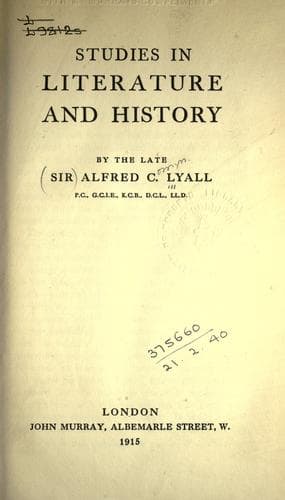
Studies in Literature and HistoryLyall, Alfred C., Sir
Religion
Studies in Literature and History
Lyall, Alfred C., Sir
English literature; History; Literature; Religion; Utilitarianism
If Joseph had written a treatise on the agrarian tenures of Egypt he
might not have bought them up so easily at famine prices, and he
might have entangled himself in a discussion upon peasant properties.
The economist who makes an inductive demonstration of unalterable
natural laws and propensities may be likened to the scientific
legislator who undertakes to codify prevailing usages: he turns an
elastic custom, constantly modified in practice by needs and
sentiments, into an unbending statute, when the bare unvarnished
statement of the principle produces an outcry. Natural processes will
not bear calm philosophic explanations that are understood to imply
approval of them as cruel but inevitable; not even in such an
essentially moralistic argument as that of Butler's 'Analogy,' which
some have regarded as a plea of ambiguous advantage to the cause of
natural religion. Malthus, for example, proved undeniably the
pernicious consequences of reckless propagation; but he who forces a
great evil upon public attention is expected to find the practical
remedy; and Malthus had little to prescribe beyond a few palliative
measures and the expediency of self-restraint, while his proposal to
abolish the poor laws in the interest of pauperism was interpreted as
a recommendation that poor folk should be starved into prudential and
self-reliant habits. Malthus held, indeed, that the improvement of the
condition of the labouring classes should be considered as the main
interest of society. But he also thought that
'to improve their condition, it is essential to impress them with
the conviction that they can do much more for themselves than
others can do for them, and that the _only_ source of their
permanent improvement is the improvement of their moral and
religious habits. What government can do, therefore, is to maintain
such institutions as may strengthen the _vis medicatrix_, or desire
to better our condition, which poor laws had directly tended to
weaken.'
There is much wisdom to be found in these counsels; but good advice
rather excites than allays the ignorant impatience of acute suffering,
and popular opinion soon began to inquire whether the _vis medicatrix_
might not be administered in some more drastic form by the State. The
conception of a rational government superintending, without
interference, the slow evolution of morals, had a kind of
correspondence, in the religious sphere, with the doctrine of
pre-established harmonies so clearly ordained that to suggest any need
of further Divine interposition to readjust them occasionally was a
reflection upon the wisdom and foresight of Providence. But the stress
and exigencies of modern party politics has rendered this attitude
untenable for the temporal ruler.
Public-domain text, read in full here on John Shaqi.
Reviews
Reviews
No reviews yet
Be the first to share your thoughts on this work.
Elsewhere in the archive
Join the Discussion
Join the discussion
Sign in to leave a comment or review.
Sign InorCreate an account