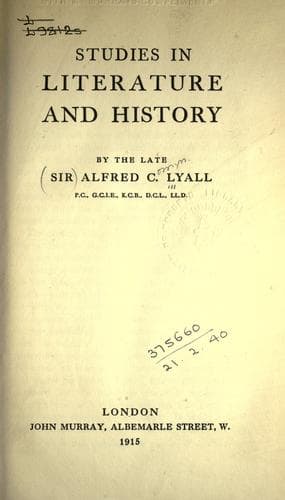
Studies in Literature and HistoryLyall, Alfred C., Sir
Religion
Studies in Literature and History
Lyall, Alfred C., Sir
English literature; History; Literature; Religion; Utilitarianism
Apart from the wrathful form, the substance of what is here said
merits consideration, for undoubtedly the most musical of our poets,
from Shakespeare and Milton to Coleridge and Shelley, are those whose
verse has embodied the richest thought and has been instinct with the
deeper emotions. We must muster up courage to remark, nevertheless,
that while in Mr. Swinburne's finest poems the musical setting
accompanies and illuminates the thought or feeling, in some others the
underlying idea is too unsubstantial; its real presence is only
visible to the eye of implicit faith. Toward his fellow poets, his
equals and contemporaries, Mr. Swinburne's attitude is that of
generous enthusiasm, not excluding outspoken, yet courteous,
indication of defects, as may be seen in the essay[37] on Matthew
Arnold's _New Poems_, which is full of important observations on
poetry in general, beside some well-deserved strictures on Arnold's
shortcomings, in criticism as well as in verse. For Victor Hugo he has
nothing but panegyric. His articles on Byron and Coleridge are
luminous appreciations of the very diverse excellences belonging to
two illustrious predecessors; while in his _Notes on the Text of
Shelley_, high-soaring and incomparable, an unlucky emendation of a
line in 'The Skylark--the insertion of a superfluous word
conjecturally--by an editor whose work he commends on the whole,
provokes him to sheer exasperation:
'For the conception of this atrocity the editor is not responsible;
for its adoption he is. A thousand years of purgatorial fire would
be insufficient expiation for the criminal on whose deaf and
desperate head must rest the original guilt of defacing the text of
Shelley with this damnable corruption.'
'Fas est et ab hoste doceri.' Mr. Swinburne has borrowed the style of
sacerdotal anathema from his mortal enemies, and pronounces it no less
inexorably. But these Notes were written nigh forty years ago, so we
may hope that by this time he has cast out, or at least subdued by
diligent exorcism, that same hyperbolic fiend which entered in and
rent him at certain seasons of his youth.
Public-domain text, read in full here on John Shaqi.
Reviews
Reviews
No reviews yet
Be the first to share your thoughts on this work.
Elsewhere in the archive
Join the Discussion
Join the discussion
Sign in to leave a comment or review.
Sign InorCreate an account