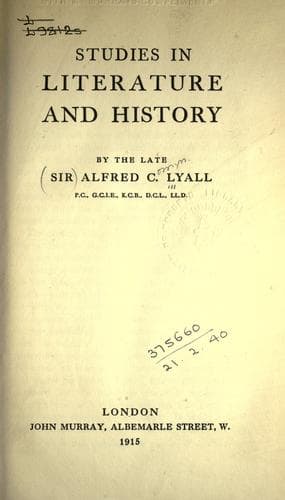
Studies in Literature and HistoryLyall, Alfred C., Sir
Religion
Studies in Literature and History
Lyall, Alfred C., Sir
English literature; History; Literature; Religion; Utilitarianism
We are compelled, unwillingly, to pass over without the notice that it
undoubtedly deserves Dr. Pennell's very impressive accounts of his
intercourse, as medical missionary, with the strange folk whom he was
trying to reclaim from savagery, of the risks which he faced with cool
courage and self-command in his travels among them, and of his quaint
theological disputations with arrogant Mullahs, whose invincible
ignorance easily convinced a congenial audience of their argumentative
superiority. His skill in surgery naturally invested him with a high
reputation among people who were incessantly fighting--he had more
success in healing their wounds than in curing their vices. His
general 'Deductions' in regard to the present state and prospect of
Christian missions in India are well worth attention, and with his
survey of the existing conditions and tendencies of religious
movements in India all who have studied the subject will generally
agree. He lays stress on the delusion that to assault and overthrow
the citadels of Islam and Hinduism, if such an achievement were
possible, would be to lay open a clear field for the success of
Christianity. 'Much more probably we should find an atheistic and
materialistic India, in which Mammon, Wealth, Industrial Success, and
Worldliness had become new gods.' Such attacks upon Eastern religion
'may for the moment win a Pyrrhic victory ... but they are at the same
time undermining the religious spirit, the ardent faith, the
unquestioning devotion which have been the crown and glory of India
for ages.' The wisdom and enlightened morality of these warnings are
incontestable. But at such questions we can only glance, although from
one point of view they may be said to have an important bearing upon
the main subject of this article.
In conclusion, we may observe that the frontiers of European dominion
in Asia are the battleground upon which the forces of archaic and
modern societies meet in arms for decisive conflict. In the ancient
world the contest was only ethnical and political; the rude tribes
were coerced into amalgamation with an expanding State, far superior
in power and usually more humane. 'The nations of the empire[40]
insensibly melted away into the Roman name and people.' But the
antique polytheism had no fanatical element; the deities of the
victorious Romans were often acknowledged and accepted by the
conquered population. Whereas in these latter days the Russians in the
Caucasus and the English on the Afghan border have discovered that in
the passionate religious animosity between Islam and Christendom lies
the mainspring of the stubborn energy and fierce hatred that so long
held their armies in check, and that still prevents the establishment
of even a pacific _modus vivendi_ on the most important frontier of
India.
FOOTNOTES:
Public-domain text, read in full here on John Shaqi.
Reviews
Reviews
No reviews yet
Be the first to share your thoughts on this work.
Elsewhere in the archive
Join the Discussion
Join the discussion
Sign in to leave a comment or review.
Sign InorCreate an account