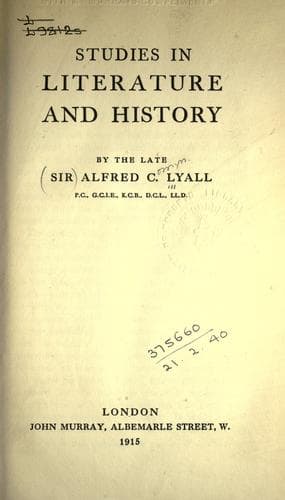
Studies in Literature and HistoryLyall, Alfred C., Sir
Religion
Studies in Literature and History
Lyall, Alfred C., Sir
English literature; History; Literature; Religion; Utilitarianism
It is cheerfully admitted by the German historians who are cited in
this volume that the train of incidents which produced so well-timed
an explosion was scientifically laid by the Prussian chancellor. But
they maintain that he was only countermining the underground
combinations of the French, who were known to be organising a triple
alliance with Italy and Austria for a combined assault upon Prussia;
and that the journey of the Austrian Archduke Albert to Paris in
March 1870 convinced Bismarck that he had no time to lose, because war
must be provoked before these alliances were consummated. And they
cite the example of Frederick the Great, who disconcerted the secret
preparations of his enemies by the sudden dash upon Dresden which
opened the Seven Years' War. This defence of his own very skilful and
not less astute manoeuvres was endorsed by Bismarck in a speech
before the Chamber in 1876; nor does it appear to us so untenable as
M. Ollivier holds it to be. He argues that the fear of being attacked
by France, if it had really influenced Bismarck's conduct in 1870,
must have been a wild hallucination, for the chancellor must have been
well aware that the emperor's policy at that time was decidedly
pacific, and that his own (Ollivier's) views were still more so. He
assures us that the project of a triple alliance was intended to be
exclusively defensive, that it never passed beyond the 'academic'
stage, or reached any practical form. The confidential negotiations of
1869 with Austria and Italy had been left, he says, in the stage of
unfinished outline, nor was it even suspected either by the French or
by the Italian ministry that they had been carried further. On the
other hand, it cannot be denied that in 1869 these negotiations had
been carried quite far enough to inspire the Prussian chancellor with
serious disquietude, if, as is very probable, he had good information
of them. We know, from M. Ollivier's very interesting account of what
passed at the first meeting of the Cabinet on July 6, when the
ministers resolved to announce to the Chamber their determination to
resent and resist the Hohenzollern candidature, that the emperor and
M. de Gramont regarded the understanding with Italy and Austria as
being much more than academic. It is there stated that when Ollivier
hesitated to accept Gramont's assurance that the assistance of these
two Powers, in the event of hostilities with Prussia, had been
virtually secured, the Emperor Napoleon took from a drawer in his
bureau certain letters written in 1869 by the Austrian emperor and the
King of Italy, and, after reading them aloud, told the ministers that
these writings undoubtedly amounted to promises of help in the
circumstances that were then actually under discussion. The Cabinet
accepted these proofs that the alliances might be reckoned upon as
substantial, so that it is not unreasonable to suppose that Bismarck
had drawn the same conclusion from the intimations that had reached
Public-domain text, read in full here on John Shaqi.
Reviews
Reviews
No reviews yet
Be the first to share your thoughts on this work.
Elsewhere in the archive
Join the Discussion
Join the discussion
Sign in to leave a comment or review.
Sign InorCreate an account