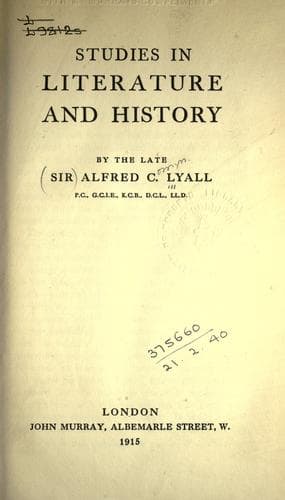
Studies in Literature and HistoryLyall, Alfred C., Sir
Religion
Studies in Literature and History
Lyall, Alfred C., Sir
English literature; History; Literature; Religion; Utilitarianism
How the French Government fell into a net that had been spread for
them is to most of us sufficiently clear. Whether the emperor and his
ministers ought to have detected and avoided it, is the real question,
and it is practically the only question that concerns M. Ollivier. In
the final pages of his book, which touch in dignified and pathetic
words upon the injustice of the reproaches that have been heaped upon
him and the rancorous calumnies by which he has been pursued, his
readers are told that, having done his best to defend the cause of his
nation, he will terminate his work without taking up his personal
justification, though on one point he desires not to be misunderstood.
It has been pleaded on his behalf, he says, that he was in fact
opposed to the declaration of war, but agreed to it under the violent
pressure of public opinion, or else from reluctance to betray internal
dissensions that would have broken up the ministry, or for other
reasons. M. Ollivier insists, on the contrary, that after Bismarck's
'soufflet' he was convinced that peace could be maintained only at
the price of his country's abject humiliation; and that he chose the
alternative of war as infinitely preferable, without the least regard
to his personal reputation or interests. We may willingly agree that
M. Ollivier acted throughout from motives of high-minded patriotism,
and although we cannot acquit him on the charge of grave imprudence we
may freely admit that he was entangled in a situation of extraordinary
difficulty. To Englishmen, who are familiar with the regular and
recognised working of constitutional government, it will be plain that
he was the victim of a system that had placed him before the public as
the nominal head of a Cabinet that he was supposed to have formed, and
of a party in the Chamber that he was expected to lead. Whereas in
fact he had no proper control over the policy of the Cabinet, and no
solid support in the Chamber. The emperor presided at the meetings of
the Cabinet; and it is clear that the ultimate decision in the
supremely important departments of the army and of foreign affairs was
still reserved to the sovereign, on whom the Foreign Secretary (as we
should call him) could urge his views separately, and from whom he
could take orders independently of the first minister. In this
radically false position M. Ollivier found himself committed to
measures on which he had not been consulted, and hurried into
dangerous courses of action for which he had no recognised official
responsibility, since they were sanctioned by the emperor's
unquestionable authority. We have to remember, also, that in July
1870, liberal institutions had been no more than six months under
trial after eighteen years of autocratic rule, that the advocates of
the old _regime_ were numerous and openly hostile to the reforms, and
that all the ministers of the new _regime_ lacked experience in the
art and practice of constitutional administration. It is among those
Public-domain text, read in full here on John Shaqi.
Reviews
Reviews
No reviews yet
Be the first to share your thoughts on this work.
Elsewhere in the archive
Join the Discussion
Join the discussion
Sign in to leave a comment or review.
Sign InorCreate an account