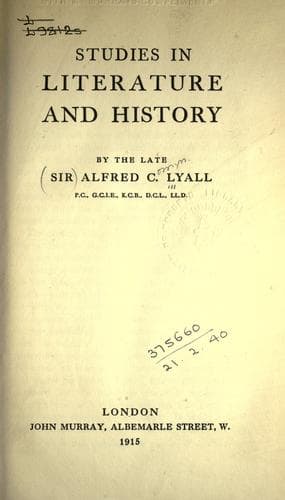
Studies in Literature and HistoryLyall, Alfred C., Sir
Religion
Studies in Literature and History
Lyall, Alfred C., Sir
English literature; History; Literature; Religion; Utilitarianism
What has been the effect of this altered situation upon the writer of
history at the present time? On such an extensive field of operations,
which has to be cultivated so intensely, he finds himself compelled to
contract the scope of his operations; he can only take up very narrow
ground. So in many instances he limits himself to a period, or even to
a single reign, to a particular class of historical personage, or to
some special department of human activity. He looks about for a plot
that he can work thoroughly; he concentrates his attention upon some
line or aspect of a subject in which he may hope that he has not been
anticipated by others. Lord Acton has laid down that 'every student
ought to know that mastery is acquired by acknowledged limitation'--he
must peg out his small holding and keep within its bounds. Histories
are now written by many and various hands--as in the case of the
Cambridge Modern History, which already counts numerous volumes--and
so the general area is divided and subdivided among experts, each of
whom dips deeply into his particular allotment, and takes heavy crops
off his ground. Yet the productiveness of the field at large seems
still inexhaustible, for there is always some new theory to be
established, some fresh vein of facts to be opened, some corrections
or additions to be made. Moreover, the experts, while they toil at
their own special work, while they attack a difficult problem from
different sides, must nevertheless co-operate with each other. Sir
William Ramsay, a noted archaeologist, tells us that for a new study
of history there is needed a group of scholars working in unison; that
the solitary historian is doomed to failure. He adds that the history
of the Roman empire has still to be re-written. The late Lord Acton,
when as Professor of Modern History at Cambridge he drew out his plan
for a modern history that would satisfy the scientific demand for
completeness and exactitude, proposed to distribute the work among
more than a hundred writers. He observed that the entire bulk of new
matter which the last forty years have supplied amounts to many
thousand volumes. When history becomes the product of many hands and
various minds the artistic element is likely to disappear.
Public-domain text, read in full here on John Shaqi.
Reviews
Reviews
No reviews yet
Be the first to share your thoughts on this work.
Elsewhere in the archive
Join the Discussion
Join the discussion
Sign in to leave a comment or review.
Sign InorCreate an account