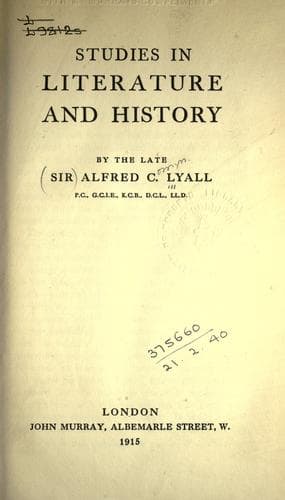
Studies in Literature and HistoryLyall, Alfred C., Sir
Religion
Studies in Literature and History
Lyall, Alfred C., Sir
English literature; History; Literature; Religion; Utilitarianism
'Both the one and the other give to what they call religion, and to
religious ideas and discussions, too large and absorbing a place in
human life. Man feels himself to be a more various and richly
endowed animal than the old religious theory of human life
allowed, and he is endeavouring to give satisfaction to the long
suppressed and imperfectly understood instincts of their varied
nature.'
No man studied more closely than Arnold the intellectual tendencies of
his generation, so that on the most difficult of contemporary
questions this opinion is worth quoting, although the ritualistic
leanings of the present day hardly operate to support it. But here, as
in his published works, his religious utterances are somewhat
ambiguous and oracular; and one welcomes the marking of a definite
epoch in Church history when he writes emphatically that 'the Broad
Church _among the clergy_ may be said to have almost perished with
Stanley.'
But correspondence that was never meant for publication is hardly a
fair subject for literary criticism. Arnold seems to have written
hurriedly, in the intervals of hard work, of journeyings to and fro
upon his rounds of inspection, and of much social bustle; he had not
the natural gift of letter-writing, and he probably did it more as a
duty than a pleasure. He had none of the ever-smouldering irritability
which compelled Carlyle to slash right and left of him at the people
whom he met, at everything that he disliked, and every one whom he
despised. Nor was he born to chronicle the small beer of everyday life
in that spirit of contemplative quietism which is bred out of abundant
leisure and retirement. A few lines from one of Cowper's letters may
serve to indicate the circumstances in which 'our best letter-writer,'
as Southey calls him, lived and wrote a hundred years ago in a muddy
Buckinghamshire village:
'A long confinement in the winter, and indeed for the most part in
the autumn too, has hurt us both. A gravel walk, thirty yards
long, affords but indifferent scope to the locomotive faculty; yet
it is all that we have had to move in for eight months in the year,
during thirteen years that I have been a prisoner here.'
If we compare this manner of spending one's days with Arnold's hasty
and harassed existence among the busy haunts of men, we can understand
that in this century a hard-working literary man has neither the taste
nor the time for the graceful record of calm meditations, or for
throwing a charm over commonplace details. And, on the whole, Arnold's
correspondence, though it has some biographical value, must
undoubtedly be relegated to the class of letters that would never have
been published upon their own intrinsic merits.
Public-domain text, read in full here on John Shaqi.
Reviews
Reviews
No reviews yet
Be the first to share your thoughts on this work.
Join the Discussion
Join the discussion
Sign in to leave a comment or review.
Sign InorCreate an account