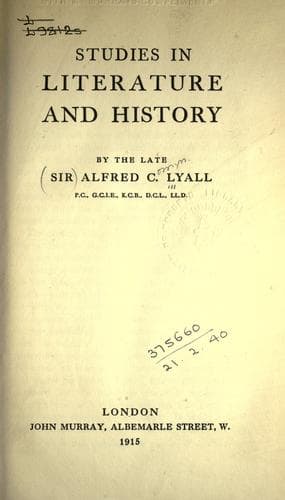
Studies in Literature and HistoryLyall, Alfred C., Sir
Religion
Studies in Literature and History
Lyall, Alfred C., Sir
English literature; History; Literature; Religion; Utilitarianism
It is good for the imaginative letter-writer to live within sight and
sound of the sea, to hear the long roll, and to see from his window 'a
nick of the blue Pacific.' It is also good for him to be within range
of savage warfare, and to take long rough rides in a disturbed
country. On one such occasion he writes:
'Conceive such an outing, remember the pallid brute that lived in
Skerryvore like a weevil in a biscuit, and receive the intelligence
that I was rather the better for my journey. Twenty miles ride,
sixteen fences taken, ten of the miles in a drenching rain, seven
of them fasting and in the morning chill, and six stricken hours'
political discussions with an interpreter; to say nothing of
sleeping in a native house, at which many of our excellent literati
would look askance of itself.'
The feat might not seem miraculous to a captain of frontier irregulars
in hard training; but for a delicate novelist in weak health it was
pluckily done. These letters would be readable if Stevenson had
written nothing else, though of course their worth is doubled by our
interest in a man of singular talent who died prematurely. They
illustrate the tale of his life and portray his character; and they
form an addition, valuable in itself, and unique as a variety, to the
series of memorable English letter-writers.
Mr. Colvin mentions, in his preface, that Stevenson's talk was
irresistibly sympathetic and inspiring, full of matter and mirth. It
cannot be denied that between correspondence and conversation,
regarded as fine arts, there is a close kinship; and very similar
reasons have been alleged for the common belief that both are on the
decline. Whether such a belief has any solid foundation in the case of
letter-writing, we may be warranted in doubting. Observations of this
sort, which have a false air of acuteness and profundity, are repeated
periodically. The remark so constantly made at this moment, that
nowadays people read nothing but magazines, was made by Coleridge
early in this century; and Southey prophesied the ruin of good letters
from the penny post. It is true that the number of letters written
must have increased enormously; it is also true that many more are
published than heretofore, and that as a great many of these are not
above mediocrity, are valueless as literature, and of little worth
biographically, they produce on the disappointed reader the effect of
a general depreciation of the standard. Nevertheless, this article
will have been written to little purpose, unless it has shown fair
cause for rejecting such a conclusion, and for maintaining that,
although fine letter-writers, like poets, are few and far between, yet
they have not been wanting in our own time, and are not likely to
disappear. There will always be men, like Coleridge or Carlyle, whose
impetuous thoughts and humoristic conceptions cannot perpetually
submit to the forms and limitations and delays of printing and
Public-domain text, read in full here on John Shaqi.
Reviews
Reviews
No reviews yet
Be the first to share your thoughts on this work.
Elsewhere in the archive
Join the Discussion
Join the discussion
Sign in to leave a comment or review.
Sign InorCreate an account