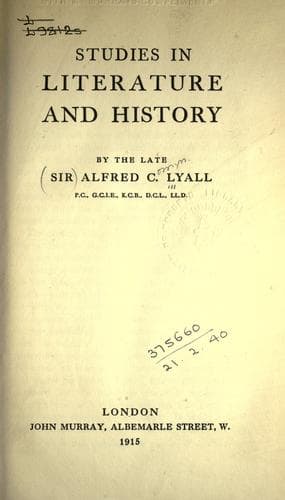
Studies in Literature and HistoryLyall, Alfred C., Sir
Religion
Studies in Literature and History
Lyall, Alfred C., Sir
English literature; History; Literature; Religion; Utilitarianism
publishing, but must occasionally demand instant liberation and
prompt delivery by the natural process of private letters. And
although the stir and bustle of the world is increasing, so that quiet
corners in it are not easily kept, yet it is probable that the race of
literary recluses--of those who pass their days in reading books, in
watching the course of affairs, and in corresponding with a select
circle of friends--will also continue. Whether Englishwomen, who write
letters up to a certain point better than Englishmen, will now rise,
as Frenchwomen have done, to the highest line, and why they have not
done so heretofore, are points that we have no space here for taking
up.
But it is the exceptional peculiarity of letters, as a form of
literature, that the writer can never superintend their publication.
During his lifetime he has no control over them, they are not in his
hands; and they do not appear until after his death. He must rely
entirely, therefore, upon the discretion of his editor, who has to
balance the wishes of a family, or the susceptibilities of an
influential party in politics or religion, against his own notions of
duty toward a departed friend, or against his artistic inclination
toward presenting to the world a true and unvarnished picture of some
remarkable personage. He may resolve, as Froude did in the case of
Carlyle, that 'the sharpest scrutiny is the condition of enduring
fame,' and may determine not to conceal the frailties or the
underlying motives which explain conduct and character. He may refuse,
as in the case of Cardinal Manning, to set up a smooth and whitened
monumental effigy, plastered over with colourless panegyric, and may
insist on showing a man's true proportions in the alternate light and
shadow through which every life naturally and inevitably passes. But
such considerations would lead us beyond our special subject into the
larger field of Biography; and we must be content, on the present
occasion, with this endeavour to sketch in bare outline the history
and development of English letter-writing, and to examine very briefly
the elementary conditions that conduce to success in an art that is
universally practised, but in which high excellence is so very rarely
attained.
FOOTNOTES:
[7] (1) _The Letters of Charles Lamb._ Edited, with Introduction and
Notes, by Alfred Ainger. London, 1888. (2) _Letters of John Keats to
his Family and Friends._ Edited by Sidney Colvin. London, 1891. (3)
_Letters and Verses of Arthur Penrhyn Stanley._ Edited by Rowland E.
Prothero. London, 1895. (4) _Letters of Matthew Arnold_, 1848-88.
Collected and arranged by George Russell. London and New York, 1895.
(5) _Letters of Edward FitzGerald to Fanny Kemble._ Edited by William
Aldis Wright. London, 1895. (6) _Vailima Letters, from Robert Louis
Stevenson to Sidney Colvin_, 1890-94. London, 1895.--_Edinburgh
Review_, April 1896.
[8] Mr. John Morley, _Nineteenth Century_, December 1895.
[9] _Dean Stanley's Letters_, p. 440.
Public-domain text, read in full here on John Shaqi.
Reviews
Reviews
No reviews yet
Be the first to share your thoughts on this work.
Elsewhere in the archive
Join the Discussion
Join the discussion
Sign in to leave a comment or review.
Sign InorCreate an account