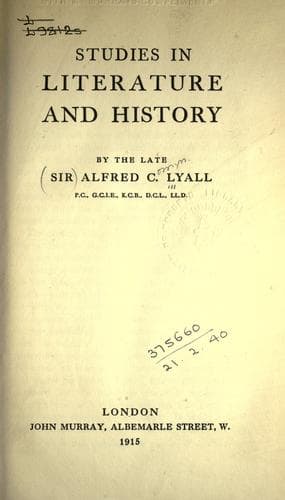
Studies in Literature and HistoryLyall, Alfred C., Sir
Religion
Studies in Literature and History
Lyall, Alfred C., Sir
English literature; History; Literature; Religion; Utilitarianism
episode of Dobbin's school life, and the story carries us more than
once to the Continent; so the introduction gives us recollections of
Charterhouse, where Thackeray went in 1822, and of travels about
Germany in the early thirties. The _Contributions to Punch_, which
form the sixth volume of this series, began in 1842, and lasted ten
years. They provide occasion for many diverting anecdotes, and for
references to his colleagues who founded the fortunes of that most
successful of comic papers; but as on this plan the biographical lines
cross and recross each other it is not easy for the reader to obtain a
connected or comprehensive view of Thackeray's career. Nevertheless as
the system fortunately affords room and reason for giving many fresh
details of his daily life, with some of his letters, or extracts from
them, which are fresh and amusing, we may cheerfully pass over these
petty drawbacks. We are heartily thankful for our admission to a
closer acquaintance with an author who has drawn some immortal
pictures of English society, its manners, prejudices, and
characteristic types, in novels that will always hold the first rank
in our lighter literature.
How his boyhood was passed is tolerably well known already. Returning
home in childhood from India he was put first to a preparatory school,
and afterwards, for nigh seven years, to Charterhouse. At eighteen he
went up to Cambridge, where he spoke in the Union, wrote in university
magazines, criticised Shelley's _Revolt of Islam_, 'a beautiful poem,
though the story is absurd,' and composed a parody on Tennyson's prize
poem, _Timbuctoo_. In 1830 he travelled in Germany, and had his
interview at Weimar with Goethe; and from 1831 we find him settled in
a London pleader's office, reading law with temporary assiduity,
frequenting the theatres and Caves of Harmony, making many literary
acquaintances, taking runs into the country to canvass for Charles
Buller, and trying his 'prentice hand at journalism. His vocation for
literature speedily damped his legal ardour, and drew him out of Mr.
Tapsell's chambers, where he left a desk full of sketches and
caricatures. In May 1832 he wrote: 'This lawyer's preparatory
education is certainly one of the most cold-blooded, prejudicial
pieces of invention that ever a man was slave to;' and he longs for
fresh air and fresh butter. By August he had fled to Paris, where he
read French, worked at a painter's _atelier_, and took seriously to
the work of a newspaper correspondent. On the romantic school, which
was just then at its height, he makes the following remark, which
betrays the antipathy to artificial and theatrical tendencies in
literature that always provoked his satire:
'In the time of Voltaire the heroes of poetry and drama were fine
gentlemen; in the days of Victor Hugo they bluster about in velvet
and mustachios and gold chains, but they seem in nowise more
poetical than their rigid predecessors.'
Public-domain text, read in full here on John Shaqi.
Reviews
Reviews
No reviews yet
Be the first to share your thoughts on this work.
Elsewhere in the archive
Join the Discussion
Join the discussion
Sign in to leave a comment or review.
Sign InorCreate an account