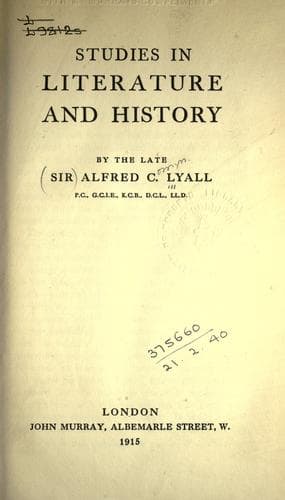
Studies in Literature and HistoryLyall, Alfred C., Sir
Religion
Studies in Literature and History
Lyall, Alfred C., Sir
English literature; History; Literature; Religion; Utilitarianism
In such fine passages as these we hear the elegiac strain of the
antique world, wherein remorseless fate held dominion over human
efforts and destiny. Like other great writers who are touched with
humorous melancholy, he falls often into the moralising vein; he stops
his narrative to address his reader with some ironical observation,
after the manner of Fielding, whose leisurely tone of satire is so
audible in the following quotation from _Pendennis_ that he might well
have written it:
'Even his child, his cruel Emily, he would have taken to his heart
and forgiven with tears; and what more can one say of the Christian
charity of a man than that he is actually ready to forgive those
who have done him every kindness, and with whom he is wrong in a
dispute?'
As we have said that _Vanity Fair_ touches the climax of Thackeray's
peculiar genius, so in our judgment _Esmond_ shows the gathered
strength and maturity of his literary power, and has won for him an
eminent place in the distinguished order of historical novelists. We
may say that the art of historical romance was brought to perfection
in our own century, although French writers trace far back into the
eighteenth century, and even further, the method of weaving authentic
events and famous personages into the tissue of a story which turns
upon fictitious adventures in love and war. The elder novelists dealt
largely in extravagant sentiment, in conventional language, and in
marvellous exploits embroidered upon the sober chronicles which served
as the framework of their drama; they were content to set upon stilts
the traditional hero or heroine of former days, whose ideas and
conversation expressed with little disguise the manners, not of the
period to which they belonged, but of the author's own time and of the
society for whom he was writing. These books are, therefore, full of
glaring anachronisms and improbabilities; the knights and dames are
sometimes (as in the _Grand Cyrus_) thinly veiled portraits of
contemporary notabilities, but they are often mere lay figures
representing the prevailing fashions of thought and feeling. The
virtuous hero abounds in judicious reflections; the heroines are
chaste and beauteous damsels--Joan of Arc herself appears in one
romance as an adorable shepherdess--and love-making is conducted after
the model of a Parisian _precieuse_.
Public-domain text, read in full here on John Shaqi.
Reviews
Reviews
No reviews yet
Be the first to share your thoughts on this work.
Elsewhere in the archive
Join the Discussion
Join the discussion
Sign in to leave a comment or review.
Sign InorCreate an account