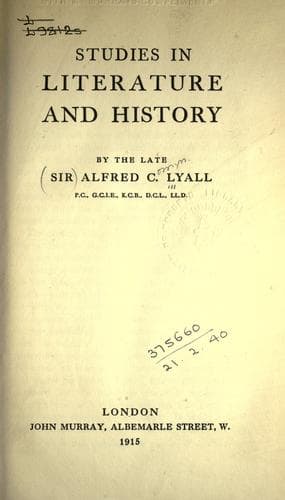
Studies in Literature and HistoryLyall, Alfred C., Sir
Religion
Studies in Literature and History
Lyall, Alfred C., Sir
English literature; History; Literature; Religion; Utilitarianism
it in the eighteenth century; though in _Esmond_ the plot, being
founded on Jacobite intrigues and conspiracies, opens with the
Revolution of 1688. He had taken great trouble, as usual, with the
localities, knowing well that you never understand a battle clearly
until you have seen its field.
'"I was pleased to find Blenheim," he wrote to his mother, "was
just exactly the place I had figured to myself, except that the
village is larger; but I fancied I had actually been there, so like
the aspect of it was to what I looked for. I saw the brook which
Harry Esmond crossed, and almost the spot where he fell wounded."'
Mrs. Ritchie quotes this letter as illustrating 'a sort of second
sight as to places which my father used to speak of'; and it certainly
attests his possession of the strong imaginative faculty which puts
together vivid mental pictures.
The first page strikes the note of disenchantment, of escape from the
spell of conventionalism and the shores of romance. Colonel Esmond,
who tells his own tale, wishes the Muse of History to disrobe, to
discard her buskins, and to deliver herself like a woman of the
everyday world.
'I wonder shall History ever pull off her periwig and cease to be
court-ridden? Shall we see something of France and England besides
Versailles and Windsor? I saw Queen Anne tearing down the Park
slopes after her staghounds, in her one-horse chaise--a hot
redfaced woman.... She was neither better bred nor wiser than you
and me, though we knelt to hand her a letter or a washhand basin.
Why shall History go on kneeling to the end of time? I am for
having her rise off her knees, and take her natural posture, not to
be for ever performing cringes and congees like a Court
chamberlain, and shuffling backward out of doors in the presence of
the sovereign. In a word, I would have History familiar rather than
heroic.'
No very deep philosophy in this, we might say, for surely historians
up to Esmond's day had not all been pompous and servile, while
something like dignity is desirable. But here we have Thackeray
speaking through Esmond his own thoughts about history, and
proclaiming the rise of naturalism against the romantic high-heeled
school. And in a much later chapter, where Esmond visits Addison, we
have the true realistic method of Tolstoi and other quite modern
novelists, as compared with the old classic style of describing war.
Addison has been writing a poem on the Blenheim campaign:
Public-domain text, read in full here on John Shaqi.
Reviews
Reviews
No reviews yet
Be the first to share your thoughts on this work.
Elsewhere in the archive
Join the Discussion
Join the discussion
Sign in to leave a comment or review.
Sign InorCreate an account