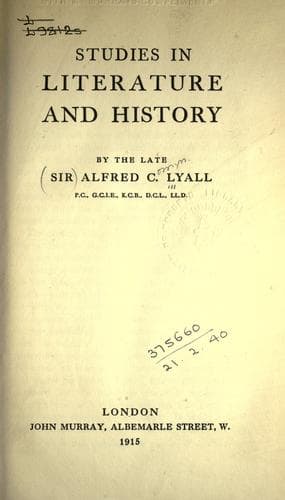
Studies in Literature and HistoryLyall, Alfred C., Sir
Religion
Studies in Literature and History
Lyall, Alfred C., Sir
English literature; History; Literature; Religion; Utilitarianism
'And now the conquerors were met by a furious charge of the English
horse under Esmond's general, Lumley, behind whose squadrons the
flying foot took refuge and formed again, while Lumley drove back
the French horse, charging up to the village of Blenheim and the
palisades where Wilkes, and many hundred more gallant Englishmen,
lay in slaughtered heaps. Beyond this moment, and of this famous
victory, Mr. Esmond knows nothing, for a shot brought down his
horse and our young gentleman on it, who fell crushed and stunned
under the animal.'
A lesser artist would have made his hero perform some brilliant
exploit; but Thackeray prefers to sketch the scene as Wouvermans might
have done it. We have not here the incomparable fire and spirit which
Scott throws into the skirmishes at Bothwell Brig and Drumclog; we see
the difference of mind and method; but we can have nothing except
admiration for the rare imaginative faculty which enabled a quiet man
of letters to deal so finely and faithfully, with such reserve and
discrimination, with a subject that might easily have been spoiled by
the noisy clatter and coarse colouring of the inferior artist. His
full length portrait of Marlborough has been too often quoted to be
reproduced here--'impassible before victory, before danger, before
defeat; the splendid calm of his face as he rode along the lines to
battle, or galloped up in the nick of time to a battalion reeling
before the enemy's charge or shot.' Of Swift, Esmond says--'I have
always thought of him and of Marlborough as the two greatest men of
that age ... a lonely fallen Prometheus, groaning as the vultures tear
him'; and with a few such strokes he gives etchings of other
celebrities in letters and politics. One may observe with astonishment
that the youthful Thackeray, who delighted in suburban chronicles, in
mean lives and paltry incidents, has risen by middle age to the rank
of an illustrious painter on the broad canvas of history. The annals
of literature contain few, if any, other examples of so remarkable a
transformation.
It is evident that Thackeray, like Scott, was an industrious collector
of material for his novels from all sources; we may refer, for an
instance, to a scene which will have left a passing impression upon
many readers, where, as the French and English armies are facing each
other on two sides of a little stream in the Low Countries, Prince
Charles Edward rides down to the French bank and exchanges a salute
with Esmond. It falls quite naturally and easily into the narrative,
and reads like a very happy original conception; yet the incident,
which is quite authentic, may be found in the papers obtained in the
last century from the Scottish convent at Paris by Macpherson.
Public-domain text, read in full here on John Shaqi.
Reviews
Reviews
No reviews yet
Be the first to share your thoughts on this work.
Elsewhere in the archive
Join the Discussion
Join the discussion
Sign in to leave a comment or review.
Sign InorCreate an account