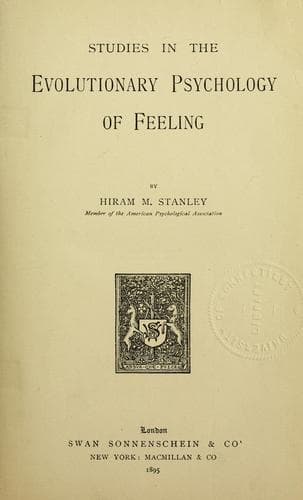
Studies in the Evolutionary Psychology of FeelingStanley, Hiram Miner
Philosophy
Studies in the Evolutionary Psychology of Feeling
Stanley, Hiram Miner
Emotions
using the most obvious facts of comparative psychology in a very general
and provisional way. We do not profess to show where, how, and when mind
originated, or what particular powers any certain organisms possess, but
we do endeavour to show how the principle of utility may be made a key
to the study of a very perplexing region of mental life—the emotions. We
proffer then merely a very general sketch of the history of emotion as a
life factor, hoping that it may, at least in its general scope, be of
service to future explorers. In taking up this subject of anger we do
then thus reiterate the position we occupy and the method we follow.
Anger like fear certainly originated at some critical point in some
individuals life as an advantageous variation of essential value. A
vital issue at some early point in the history of life determined the
genesis of this new psychic mode and function as a stimulant of
aggressive will action. Very likely it was in competition of organisms
for food that some favoured individual first attained the power of
getting mad and violently attacking its fellows, and so obtaining
sustenance. However this may be, certain it is that a direct attack is
often more self-conservative than attempts at escape when injury
threatens; it is a greater advantage to destroy pain-giver than to shun
it. Fear enables organisms to avoid loss, but it does not accomplish
positive gain, as anger does through overcoming hindrance. Anger is
often also more economical for the forces of the organism, and thus, in
general, predacious animals are longer-lived than even those of their
prey who may attain a full length of life. Even in the face of great
odds a direct attack is often more serviceable than attempt at escape.
Anger is certainly the primitive motive force of all offensive action,
though of course we cannot say that the animal got mad because it saw
the serviceability. Psychic evolution, at least as far as new powers are
concerned, never comes by teleologic foresight, and, indeed, cannot by
the nature of the case. The animal did not definitely set out to get
angry because it foresaw the value, yet in the earliest angers there
must have been effort, a certain _nisus_ which marked the new form as a
real attainment, a marked achievement. That the provoking occasion gives
rise now to anger inevitably and naturally, that anger comes upon us and
overcomes us is true enough, but in its earliest phases anger must have
been, like other just evolving factors, supported only by powerful will
effort. The oftener the early psychism got mad, the easier it got mad.
Facility came only by practice, and a large variety of occasions,
besides the simple critical and original one, were gradually utilized by
the anger faculty. But in its original form and occasion anger was, no
doubt, akin to that we see when an extremely timid animal at the last
extremity will turn in anger and fiercely fight for its life. Such an
Public-domain text, read in full here on John Shaqi.
Reviews
Reviews
No reviews yet
Be the first to share your thoughts on this work.
Elsewhere in the archive
Join the Discussion
Join the discussion
Sign in to leave a comment or review.
Sign InorCreate an account