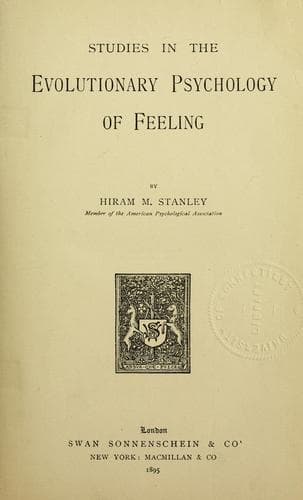
Studies in the Evolutionary Psychology of FeelingStanley, Hiram Miner
Philosophy
Studies in the Evolutionary Psychology of Feeling
Stanley, Hiram Miner
Emotions
In all its later stages anger, and likewise hate as well, and all the
allied emotions, attach only to what is distinctly known as animate. The
futility and self-destructiveness of anger against the inanimate and
insentient comes to be fully recognised. But early anger is quite
undiscriminating. The hunter, who, pursued by an enraged bear, scatters
his clothes and accoutrements behind him for the bear to tear in pieces,
takes advantage of the unintelligent anger of the bear for his own ends.
Since animals do not wear clothes they have no conception of what they
are as independent insentient things distinct from the wearer. To the
bear the weapons and clothes dropped by the hunter appear not as
inanimate beings, but as living, vitally-connected parts of the creature
pursued. The error arose, not from senselessness, but from lack of range
of experience, and it is akin to the error of the ancient Mexicans who,
having never seen a horse by itself, regarded a man on horseback as a
single creature. A dog, the first time he sees his master unclothed, is
greatly puzzled, and but slowly learns that clothes are something the
master has and not what he is. When weapons, clothes, etc., are at
length distinguished as property, there is yet a natural and right
impulse to destroy them as injuring the owner; but the animal which
stops to do this commits an error of judgment, as it is usually of more
importance to despatch the hunter than to destroy his implements. It is
the tendency of anger to destroy all which is in any wise connected with
its object. This is true, not only of the animal world, but also of the
lower human development. A savage in a fit of fury will slay, not only
an offending fellow, but also his family and relations, and also destroy
all his property. The uselessness, not to say the injustice, of such an
indulgence of anger is only recognised at a comparatively late stage of
evolution. Anger in its later form concerns itself only with purposive
offence in its object, and vents itself solely on the individual
offending. A clear distinction is drawn between animate and inanimate.
Thus, my dog, playing with another, hurt itself by running into a tree,
and gave an angry growl; but noticing the real nature of the paingiver
as, not the other dog, but an inoffensive tree, his attitude immediately
changed, and he seemed to take the injury as a matter of course. A puppy
would in like case senselessly continue its demonstrations of anger to
no good and perhaps to its own injury.
Public-domain text, read in full here on John Shaqi.
Reviews
Reviews
No reviews yet
Be the first to share your thoughts on this work.
Elsewhere in the archive
Join the Discussion
Join the discussion
Sign in to leave a comment or review.
Sign InorCreate an account