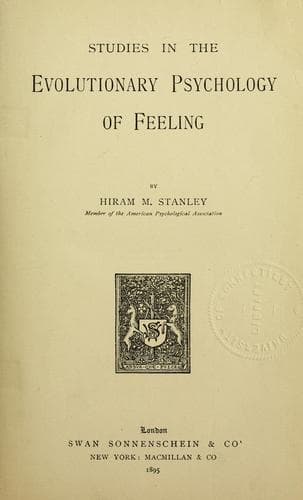
Studies in the Evolutionary Psychology of FeelingStanley, Hiram Miner
Philosophy
Studies in the Evolutionary Psychology of Feeling
Stanley, Hiram Miner
Emotions
The function of hate is, like anger, to injure and eliminate the
injurious; but what anger accomplishes by a sudden volcanic outburst,
hate accomplishes in a slower, but surer and more subtle way. Hate is,
as previously pointed out, a manifest improvement over anger as a method
of offensive warfare. Other things being equal, the best hater is the
most successful individual. Dr. Johnson had reason on his side when he
said that he loved a good hater. A strong hater, who pertinaciously
assails and injures his enemies, strengthens his own position and makes
the largest place for himself in life. Hate, as a permanent,
economically aggressive motion, marks certainly a great advance, and is
of the highest import for life. If now hate has its own function as
direct stimulus to offensive action toward those who will be injurious,
toward those who are capable and likely to pain and harm us, how shall
we explain the hate—and we might say anger as well—which arises at mere
remembrance of injury, and which seems to have no immediate value for
life?
In the first place we may well doubt whether any purely retrospective
emotion exists, at least in early psychic life. The past, of course, has
no value in and by itself; it is irretrievable, and emotional force
spent upon it as such wasted—“no use crying for spilled milk.” It may
well be that for simple psychisms the past never exists as such; at
least, it is never a stopping point, but a mere _datum_ for interpreting
the inexperienceable. The sense of experience, especially in its
temporal aspect, is very difficult of analysis; yet we may say with some
confidence that at first it does not imply a sense of either the past or
future as such. The mind is immediately impressed by the injuriousness
of the injurious, which, though coming, of course, in terms of the
experienced, is not relegated thereby to a past time, nor is it at all
dwelt upon as such for emotion reaction. Primitive emotion is not
backward looking; for this is in itself entirely futile, and primitive
life depends for its existence and progress upon utility. The value of
emotion is in stimulating preparedness for defence and offence. The
representation of injury inflicted comes up to early mind as some injury
being inflicted, or imminently so, or is applied at once in
interpretation of the experienceable, with no thought or emotion for it
as merely past fact. Advanced psychic life may stop at the first step,
may indulge in retrospection for its own sake, and not for its immediate
value in understanding the experienceable, but primitive emotion is ever
an alertness and anticipatory readiness.
If, now, we turn to some classification of the anger group in itself and
in its general relation to emotion, we obtain something like the
following:—
Public-domain text, read in full here on John Shaqi.
Reviews
Reviews
No reviews yet
Be the first to share your thoughts on this work.
Elsewhere in the archive
Join the Discussion
Join the discussion
Sign in to leave a comment or review.
Sign InorCreate an account