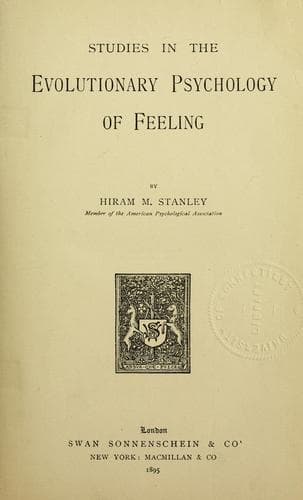
Studies in the Evolutionary Psychology of FeelingStanley, Hiram Miner
Philosophy
Studies in the Evolutionary Psychology of Feeling
Stanley, Hiram Miner
Emotions
The first step in life is to get an experience, to struggle into a
consciousness which may be immediately valuable, and which is at once
emotional and motor in its action; the second step is to compare and
identify the experience gained so as to ascertain its meaning for life
with greater certainty. Recognition thus comes early into play, but
while the sphere of the sense of the novel lies in that of the
unrecognised, it does not in any wise occupy the whole, for much that is
unrecognised still is far from conveying feeling of novelty, because
this feeling is, as we have said, far from being experienced on every
presentation of the novel. The novel is equivalent rather to the
unrecognisable. A dog may lose in a few months the power of recognising
its master, yet the master after such a lapse of time cannot be said to
awaken sense of novel. Though not recognised for master he is recognised
as one of many familiar objects, he is known to be a man, and that is as
far as the identification goes. The experience then is in reality not a
fresh one. Here is a new man but there is nothing novel in the
experience, much less is there a feeling of novelty. I doubt much if a
dog or any lower animal notices and appreciates pleasurably or painfully
the novel as such. The unrecognisable and unclassifiable presented to
them may agitate them in various ways, as contrast a horse and a
courageous dog on first seeing a locomotive, but there is no evidence of
real feeling of the novelty of the experience as such. The enjoyment of
the novel for its own sake is probably wholly confined to late human
psychism.
Public-domain text, read in full here on John Shaqi.
Reviews
Reviews
No reviews yet
Be the first to share your thoughts on this work.
Elsewhere in the archive
Join the Discussion
Join the discussion
Sign in to leave a comment or review.
Sign InorCreate an account