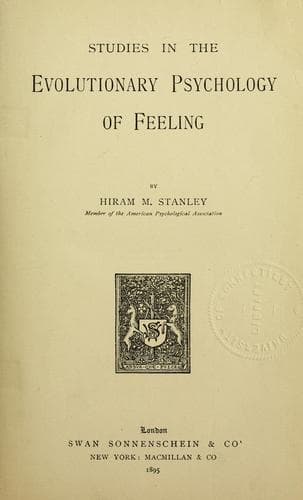
Studies in the Evolutionary Psychology of FeelingStanley, Hiram Miner
Philosophy
Studies in the Evolutionary Psychology of Feeling
Stanley, Hiram Miner
Emotions
Perhaps the latest developed form of sorrow is the feeling of sadness
which comes over one in reflecting upon pain as a universal fact of
existence. The pessimistic mood, with its converse, the optimistic, as
based on philosophic generalization, is certainly extremely late. Pain
at pain in general, pleasure at pleasure as a purely general fact, are
equally remote from primitive modes, and mark culminating phases. While,
perhaps, there is a certain justification and value in being saddened by
the spectacle of universal pain, yet a gravity rather than a despondency
is its proper measure. Pain, punitive and premonitory, plays, as we have
already noted more than once in our discussions, a most beneficent and
essential part in the struggle for existence and in all the higher
struggle. It is a necessary and salutary phenomenon, involved in the
very nature of evolution by struggle; hence he who impugns pain and is
offended at it, really impugns the psychic nature of things and desires
with Schopenhauer the annihilation of will. As a matter of fact the
extreme pessimistic spirit is more destructive to progress than even the
most buoyant optimism, in that it nips all earnest and forceful activity
in the bud. A foolishly happy-go-lucky activity is better than a
paralysis of effort through conviction of its inherent painfulness and
ultimate inutility. The scientific evidence, so far as we can now read
it, points decisively to the belief that pain-will activity, an intense
struggle, is the earliest mind, and the condition of its birth has been
the law of its development, and for aught that we can see, ever will be.
Into this we are born, and it is as foolish to run counter to it as to
the law of gravitation. A philosophy which runs counter to reality must
either build a new reality or subside; but it is most certainly to be
doubted whether the philosophic spirit ever has or ever will determine a
general innovation in psychic evolution. But we cannot do more than
merely advert to these large questions here.
With reference to the development of sorrow it is an obvious remark that
much which causes grief in the earlier stages of mental growth ceases to
have that effect with maturer experience. Thus the man may not notice,
or may laugh at, or may feel irritation at occasions which in his early
life would have wakened grief. On the contrary, much that seems grievous
to the old is not so regarded by the young. In general, grief tends to
become less frequent and paroxysmal, but more profound and lasting with
the growth of mind.
Public-domain text, read in full here on John Shaqi.
Reviews
Reviews
No reviews yet
Be the first to share your thoughts on this work.
Elsewhere in the archive
Join the Discussion
Join the discussion
Sign in to leave a comment or review.
Sign InorCreate an account