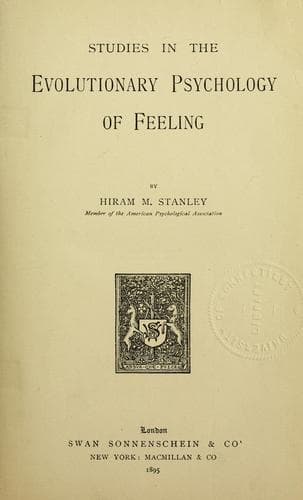
Studies in the Evolutionary Psychology of FeelingStanley, Hiram Miner
Philosophy
Studies in the Evolutionary Psychology of Feeling
Stanley, Hiram Miner
Emotions
The general function which desire subserves in stimulating advantageous
action is obvious. As anger and fear are primarily useful emotions in
view of potential pain and harm, so desire in view of potential pleasure
and benefit.
The function of desire in stimulating advantageous action is obvious.
Desire answers to potential pleasure and benefit just as anger does to
potential pain and harm. It is a correlative and supplement of fear, and
in general the more one fears a thing the more one desires the opposite.
When sailing I desire fair weather in proportion as I fear a squall.
Desire is the very spring of life and progress, and when desire is
extinguished the will to live ceases, and psychic life declines and
dies. Fulness of desire is fulness of life, and the largest mental life
is that in which desire, constant, multiplex, and far-reaching, is
strong and dominant. Desire seems thus to be a permanent factor, and,
though there is a pre-desire period, no post-desire age seems to be
indicated in psychic history so far.
Somewhat as to the analysis of desire has already been intimated in
touching upon its origin and function, but we are now to study its
elements more in detail. The very young infant certainly experiences
hunger pains in almost its initial consciousness; but it is only
gradually that the need felt leads up to presentation and representation
of the needed thing, and so to desire. Hunger with it, as with all
organisms, sharpens the wits, and leads to knowing things, interpreting
them, and acting definitely toward them. Through touch it first comes to
appreciate object, and object as food, a representative–inductive act.
The earliest meaning attached to object is edibility, and this, indeed,
indiscriminately to all objects, as we see that infants mouth
everything. Gradually from this, or by dint of a good deal of unpleasant
experience, objects are divided into edible and non-edible, the
primitive classification of things.
Public-domain text, read in full here on John Shaqi.
Reviews
Reviews
No reviews yet
Be the first to share your thoughts on this work.
Elsewhere in the archive
Join the Discussion
Join the discussion
Sign in to leave a comment or review.
Sign InorCreate an account