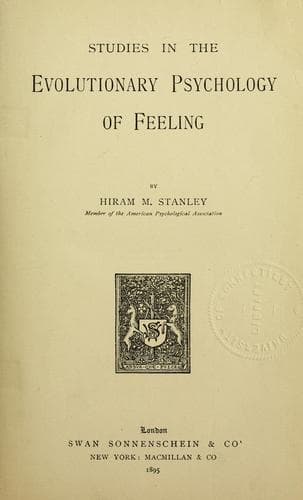
Studies in the Evolutionary Psychology of FeelingStanley, Hiram Miner
Philosophy
Studies in the Evolutionary Psychology of Feeling
Stanley, Hiram Miner
Emotions
Desire is certainly a very extensive psychic _genus_ including many
varieties which are noted by common introspection, and which are even
denoted by special words. A wish is a momentary act of desire, longing
is intense form; ambition and aspiration are desires for higher order of
objects, as contrasted with desire for food or dress. The kinds as
distinguished by object are numberless since any object may be
desirable, and the realm of the desirable is coincident with the realm
of the knowable. In the course of evolution we become aware of things
and of states of consciousness, so that by feeling about them—having
emotions—there may result the advantageous action with reference to
them. This order, not consciously apprehended of course, is the natural
order of psychic events, and one which, in tendency at least, always
appears, even in latest evolutions. The desire to know what is the full
experience value of things, curiosity, is an early acquirement, since
complete cognition of object is obviously of the greatest advantage,
especially to the weaker animals, as deer, who act wholly on the
defensive. The very strong can afford to be largely indifferent to their
environment.
With reference to intensity, we can place forms from a positive to a
negative pole. Thus with a famished man desire for food is first intense
craving, becoming with continued eating moderate desire, then feeling of
satisfaction, then of repletion, then negative, as aversion in passive
form or satiety, then becoming active as disgust, and intense as
loathing. Content, or desire satisfied, is not desire extinguished,
rather it is an equilibrium wherein desire and its function are in
continual equalizing action. When desire granted means all desire
extinguished, with beings of any high tendency to activity _ennui_ is
the result. Here, as Schopenhauer notes, wish for a wish develops. Even
in complete pleasurable quiescence, there is desire for its continuance,
which is only saying that there can be no complete quiescence short of
coma, or else of a state where reality has never broken in, and
experience is wholly unformed where the being cannot anticipate or note
change. Pure and absolute content never occurs, and as a matter of fact
never will, the point of transition in the desire gamut, in passing from
positive to negative, being like a mathematical form, unreal and
theoretical. When positive desire ends, negative desire springs up
immediately, just as in the pleasure-pain gamut, where the indifference
point of transition has no existence in reality.
Public-domain text, read in full here on John Shaqi.
Reviews
Reviews
No reviews yet
Be the first to share your thoughts on this work.
Elsewhere in the archive
Join the Discussion
Join the discussion
Sign in to leave a comment or review.
Sign InorCreate an account