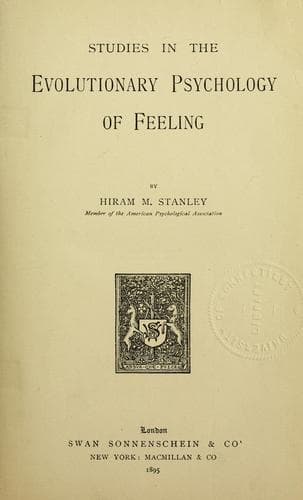
Studies in the Evolutionary Psychology of FeelingStanley, Hiram Miner
Philosophy
Studies in the Evolutionary Psychology of Feeling
Stanley, Hiram Miner
Emotions
As to the origin of attention, it must arise with cognition itself. The
past act of cognition was, as we have seen (p. 61), a powerful will act,
an achievement through struggle, and therefore an attention. The history
of cognition and of its ultimate development into the highest forms is a
story of incessant and fierce competition in the struggle of life. Man’s
power of sense, perception and thought is an inheritance from an immense
deal of will effort by untold millions of ancestors. The necessities of
existence compelled an alertness, a general cognitive strain, which
effected progress and discovery, the attainment and integration of new
and most valuable forms of experience which have been handed down to
later generations. The earliest cognitive life is then almost entirely
attentive; cognition does not _come_, it must be _attained_. Gradually,
however, some low form like general sensation is so integrated, and
requires less and less attention, till it _comes_, is _given_, with
comparatively no effort, and a state of unattention thus appears in
consciousness. The child repeats quickly, easily, without attention, the
evolution of the past, and this spontaneous re-enactment continues up to
the full point of hereditary integration. Without effort the child is
carried on at the incitement of instinctive inherent interest up to a
certain comparatively high grade of experience. But heredity _momentum_
gradually ceases, and if there is to be individual progress, attention
must come in. Thus, intellectual education is fundamentally a developing
of attention. Conscious control of cognition, both positively and
negatively, becomes more and more efficient, and the progress of the
race is dependent on exceptional attention in exceptional
individuals—geniuses. Attention becomes more and more limited and
specialized, and a minute subdivision of labour results.
Public-domain text, read in full here on John Shaqi.
Reviews
Reviews
No reviews yet
Be the first to share your thoughts on this work.
Elsewhere in the archive
Join the Discussion
Join the discussion
Sign in to leave a comment or review.
Sign InorCreate an account