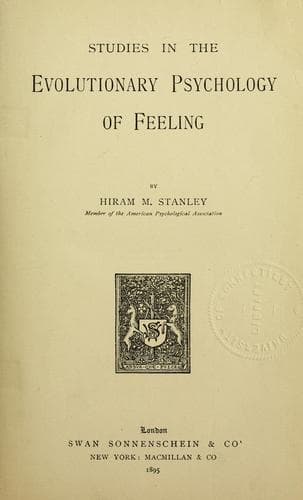
Studies in the Evolutionary Psychology of FeelingStanley, Hiram Miner
Philosophy
Studies in the Evolutionary Psychology of Feeling
Stanley, Hiram Miner
Emotions
The simplest method and the most direct of studying the rise and nature
of self-consciousness is in those experiences in coming to
self-consciousness from deep sleep or from coma after severe accident. I
say, “I regained consciousness,” “I came to consciousness,” meaning, not
bare consciousness as in mere sensations or perceptions, but a
self-consciousness involved therein. In becoming conscious I came to
self-consciousness; in becoming aware of the objective, I at once
realize my subjectivity, myself as experiencer. In coming out from under
the influence of chloroform, there is, I have distinctly observed in my
own case, a struggling to realize, which is both objective and
subjective cognition. It is true a person having awakened under very
strange circumstances, as in a bed in a hospital after an accident, may
declare, “I did not know myself,” but this does not mean that he had no
self-consciousness, but merely that for the moment he did not identify
this self, himself, as John Smith, of Jonesville, etc. Sometimes it
happens that self-identification is not reached at all, but the self, as
bodily whole experiencing, is speedily aware of self, a new personality
and sense of personality quickly grows up. Again, a lunatic mistaking
_himself_ for Herod or Cæsar is thus always self-conscious. He has
consciously established himself as the self playing a part in the world,
but according to the opinion of his sane fellows he is much in error as
to what that part is. Strictly speaking, there is no illusion of
self-consciousness, except under the impossible supposition that a being
not a real self or psychic individual should have self-sense; but the
very act of self-cognizance implies reality of self-hood. It is plain
that even the insane man who regards _himself_ as tree or stone, has,
however, the act of self-regard, is really self-conscious. Strictly
speaking, we cannot identify or recognise self, for sense of self is
necessary in any recognition to make it such, a self-consciousness is a
fundamental _prius_. You recognise a tree, a house, but you do not
recognise yourself except as yourself is mere object related to you, to
your experience. Self-identification means only objective act, and is
not, then, the same as self-consciousness, though based upon it.
Public-domain text, read in full here on John Shaqi.
Reviews
Reviews
No reviews yet
Be the first to share your thoughts on this work.
Elsewhere in the archive
Join the Discussion
Join the discussion
Sign in to leave a comment or review.
Sign InorCreate an account