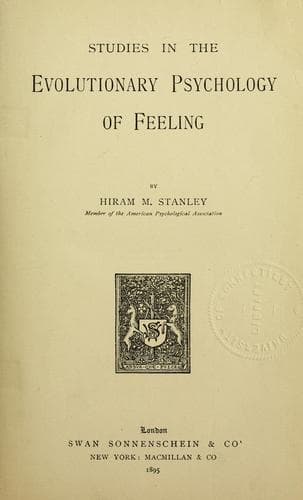
Studies in the Evolutionary Psychology of FeelingStanley, Hiram Miner
Philosophy
Studies in the Evolutionary Psychology of Feeling
Stanley, Hiram Miner
Emotions
We infer, then, that self-consciousness is first reached and maintained
in the sensing act as definite cognitive volition. To sense warmth and
cold is simply a little earlier objectification than to attain sense of
a light or a sound. To _feel_ is as active as to look or to listen. We
know that there are modes of force an appreciation of which does not now
enter into known psychosis, but which might be sensed through long and
severe effort and evolve a new sense-organ. Thus, if the conditions of
life had demanded it, there would have arisen in the struggle of
existence a magnetic sense, though now a man may place his head between
the poles of the strongest magnet and be unable to reach any sensation.
A magnetic sense once organized and inbred into experience would act
with the same apparent spontaneity, as a “_given_,” as does such a
sensation as that of heat; and a person feeling magnetic would have
self-feeling implied the same as in feeling warm. That feeling warm with
us denotes something which possesses consciousness rather than
consciousness by struggle possessing it, is simply the result of the
inheritance of the accumulated mental force by which past generations
have reached this sense, and thereby consolidated self-consciousness
with it, for self-consciousness is built up as reflex cognition from the
cognitive effort and willing of the individual. Sensation always begins
in a sensing, a volition of the individual to realize externality in its
experience value, that is, mode of affection of its own body, as in
feeling warm pleasurably or painfully. When the objective is not merely
sensed but perceived, when object and objects are definitely cognized,
self-consciousness is greatly furthered, as each object and objectifying
cognizance means self-reference or interpretation in terms of
self-experience.
That self-consciousness is early and fundamental psychosis, is apparent,
not only from the gradual losing consciousness on going to sleep or in
gaining consciousness in waking, but also from the fact of its being
universal in dream life. Those factors which remain throughout all
stages and kinds of dream life, are justly regarded as organic and
basal. The higher and later elements, those which are still nascent and
in the volitional stage, as conscience and reason, rarely or never occur
in dreams. In the slightest dreams there is personal quality; I am
consciously experiencing, I am walking, riding, looking, hearing, etc.
An awareness of self pervades all dream life, even in its lowest form.
We are constantly in a world of objects which we are conscious of in
their experience value as affecting us or to affect us. A person
relating a dream always narrates it as personal experience and so
felt—“I dreamed I was in a cave and I heard water running and I felt it
cold,” etc., etc. As far then as we can survey dream life, it is a
significant fact that self-consciousness pervades it.
Public-domain text, read in full here on John Shaqi.
Reviews
Reviews
No reviews yet
Be the first to share your thoughts on this work.
Elsewhere in the archive
Join the Discussion
Join the discussion
Sign in to leave a comment or review.
Sign InorCreate an account