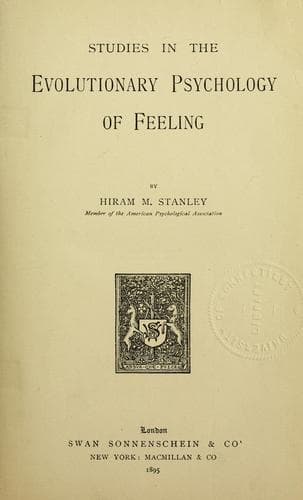
Studies in the Evolutionary Psychology of FeelingStanley, Hiram Miner
Philosophy
Studies in the Evolutionary Psychology of Feeling
Stanley, Hiram Miner
Emotions
A child fears the dog and is proud of its new dress. Here are two
emotions which both imply self-consciousness, the object is in both
related to the self, but they differ in egoistic quality in that in the
fear there is sense of the thing as acting on the self, in the pride
there is sense of the self as acting on the thing. In the pride it is
the object as identified with the self that is the source of emotion.
The pride proceeds from within outward, while fear, _vice versâ_. In
fear it is the experience value of the dog, that it will hurt, that
gives the emotion quality; but in the pride the essence of the emotion
lies, not in the influence of the dress on the self, but that the self
is connected with the dress by way of ownership. “See my pretty dress”;
“Oh mama! the cross dog”; the emotions thus expressed appear to belong
to different orders; the fear being of the thing in its effect on the
self, the pride being of the self in the thing. Pride is a glorified
self-consciousness, self-consciousness is its substance and immediate
spirit, whereas in fear self-consciousness is but an instrument in
interpretation of experience value. We observe an interesting example of
emotion of personality in a young girl who fears a cow and is yet
ashamed of her fear. Here, while self-consciousness is certainly
involved in the fear, yet it is peculiarly involved in the emotion at
her emotion as such; the shame is at or of herself, the fear is for
herself. This peculiar personal feature of pride is signified by the
common usage of language; the child is proud of the thing, does not
pride the thing, but prides himself on the thing, whereas in fear he
fears the thing for himself. I say, indeed, the child is afraid of the
dog and proud of his dress, but the force of the preposition is quite
general.
It may be said that pride is not peculiarly an emotion of personality
simply as being directed toward self; one can hate himself, fear
himself, be angry at himself, etc. But the drunkard fearing himself
means merely that he fears the results of his own tendencies, _delirium
tremens_, for instance, a perfectly objective fear. And it is evident
that one cannot, holding to the term, self, in the same meaning, fear at
once himself for himself. The self which is endangered is not the self
which endangers. In all such cases as so-called fearing self the action
is from without inward, which is the reverse of the mode in
personality—emotion where oneself is seen, not as affected by the thing,
but as himself in the thing.
Public-domain text, read in full here on John Shaqi.
Reviews
Reviews
No reviews yet
Be the first to share your thoughts on this work.
Elsewhere in the archive
Join the Discussion
Join the discussion
Sign in to leave a comment or review.
Sign InorCreate an account