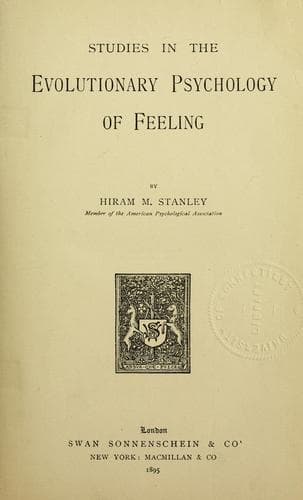
Studies in the Evolutionary Psychology of FeelingStanley, Hiram Miner
Philosophy
Studies in the Evolutionary Psychology of Feeling
Stanley, Hiram Miner
Emotions
That induction, as giving the experience value of things on basis of
previous experience, is fundamental to all emotions about the things,
has been implied throughout our discussion. But the inductive act may
itself be emotively considered and intellectual emotion may arise. How
and why induction came to be a pleasurable act and carried on for its
own sake is, perhaps, not explainable by biologic evolution. It is
certain that the inductive act, like other functions, arises as painful
effort and as a mere means of serving life. Identifying and recognising
is accomplished only under pressure of the struggle for existence.
Animals in general, and, indeed, most human beings exercise their
intelligence, make inductions, only as compelled by the demands of life.
The Australian savages who guided Lumholtz in his search for new
marsupials knew about the animals solely in a practical way, and were
totally unable to comprehend Lumholtz’s motive. So geologists examining
stones are entirely misapprehended by savages and the semi-civilized,
though these people are sufficiently acquainted with stones so far as
they are a source of mineral wealth, are useful for building, etc. And
from the point of view of natural selection pure science, the pursuit of
knowledge solely for its own sake, without the least reference to its
appreciation, is unexplainable.
Nevertheless, it is a fact that at a certain point in psychism the
intellectual life develops for its own sake; the inductive act is
pleasurable, and the desire arises to continue it as such, that is, here
is true intellectual emotion, an emotion arising about an intellectual
act represented as such. This feeling about induction may rise to an
absorbing passion, as with Charles Darwin. He liked nothing better than
making inductions, until he finally came to like little else. If the
reason is asked for induction becoming pleasurable, and an end in itself
psychology at present has no answer.
Public-domain text, read in full here on John Shaqi.
Reviews
Reviews
No reviews yet
Be the first to share your thoughts on this work.
Elsewhere in the archive
Join the Discussion
Join the discussion
Sign in to leave a comment or review.
Sign InorCreate an account