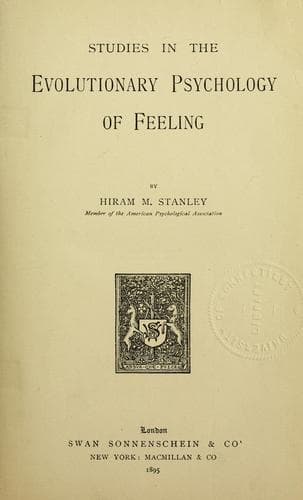
Studies in the Evolutionary Psychology of FeelingStanley, Hiram Miner
Philosophy
Studies in the Evolutionary Psychology of Feeling
Stanley, Hiram Miner
Emotions
A theory of the origin of æsthetic psychosis which has been pressed by
some, as by Herbert Spencer, is that it arises as reflex from
spontaneous outflow of energy, or more particularly in connection with
play impulse. A horse turned loose in pasture may gambol, running,
sniffing, looking around, all which denoting a free outflow of energy
through lines of least resistance, the customary channels of activity.
But we cannot seriously think that in this sensing and muscular activity
there is implied any real æsthetic psychosis, and indeed it seems quite
emotionless. The emotion of fear or similar feelings aroused the
original activities, but this present galloping, etc., is automatic, and
such immediate pleasure as may result from this free activity is
scarcely of the æsthetic order. The whole is of a distinctly lower order
than the original activity and much below æsthetic quality. If we recall
our own state of mind in youthful “letting off steam” and in plays, we
do not find æsthetic pleasure. There is, however, a pleasure of relief
and also positively a pleasure from such spontaneous outflow; but the
outburst of pent-up energy automatically spent along lines of race
action is a mere echo, dies out at once, and as degenerate form is not a
starting point for origin of any new psychosis. Play as simulation of
feeling and action is also removed from æsthetic activity, as in a dog
playing at fear and running, or at anger and chasing. He gets a more or
less modified fear or anger, but there does not seem to be any tendency
to æsthetic psychosis. Mere imitation is more or less exact and skilful,
but emotion therein and thereat is plainly not the glow of æsthetic
emotion, but is reflex of sense of power and intelligence as qualities.
Mimicry as mere outlet of energy as with monkeys is plainly not
aesthetic; here is merely an automatic outflow of force into suggested
activity. When a savage as mimetic achievement carves the figure of man
as handle to a knife, he accomplishes art, but not fine art. He has no
more æsthetic feeling than a boy or man whittling out a ship, it being
merely an exact and skilful counterfeit of a real thing. Imitation for
the sake of imitation or to deceive is a teleologic pleasure distinct
from æsthetic. Successful imitation is often said, indeed, to be
“beautifully done,” but this means no more than well done. Even a
well-baked cake is popularly spoken of as beautifully done.
Public-domain text, read in full here on John Shaqi.
Reviews
Reviews
No reviews yet
Be the first to share your thoughts on this work.
Elsewhere in the archive
Join the Discussion
Join the discussion
Sign in to leave a comment or review.
Sign InorCreate an account