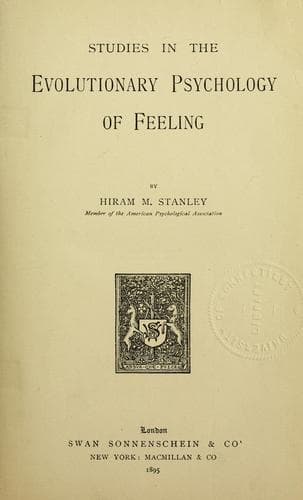
Studies in the Evolutionary Psychology of FeelingStanley, Hiram Miner
Philosophy
Studies in the Evolutionary Psychology of Feeling
Stanley, Hiram Miner
Emotions
With the rise of beauty we have a new utility. Here is a new pleasure
which once experienced is sought and sought again, is developed, and
with some natures becomes absorbing passion, the life. Objects fitted to
give this pleasure are desired, are bought and sold. The beautiful is
used to effect all kinds of ends. The lover adorns himself to make
himself attractive, the advertiser distributes his bills in artistic
shape, the real estate dealer ornaments his houses and grounds. Whatever
will afford æsthetic pleasure we are willing to pay for and pay high. In
fact, in the person of a Patti the æsthetic thrill becomes the most
expensive taste which humanity can indulge. Art then is a utility—a
something which satisfies desire—and as such it is not free or
shareable. But one at a time can observe a picture from the best point
of view. Rich men buy the most sightly spots in nature, the places of
magnificent vistas and open to beautiful sunsets. Beautiful things are
then desirables just like edible things or warm things, and as such they
are not shareable. The feeling for beauty, just because it is
self-contained, is far from being disinterested. It is essentially
selfish.
CHAPTER XVIII
_THE PSYCHOLOGY OF LITERARY STYLE_
Mr. Herbert Spencer’s famous essay, entitled, “The Philosophy of
Style”—by which is meant the Psychology of Style—propounds what we may
term the economic theory of literary effect. The secret, he tells us, of
the pleasing effect of diction, rhythm, figurative language, sentence
structure, lies in this, that these are labour-saving devices to
economize mental effort, that by their use we get with the least
attention the greatest apprehension; and hence we receive pleasure as
reflex of the facile and full cognition functioning. Literary pleasure
is thus brought under the law of pleasure in general. Take the quotation
from Shelley cited by Mr. Spencer:—
“Methought among the lawns together
We wandered, underneath the young grey dawn,
And multitudes of dense white fleecy clouds
Were wandering in thick flocks along the mountains,
Shepherded by the slow unwilling wind.”
Public-domain text, read in full here on John Shaqi.
Reviews
Reviews
No reviews yet
Be the first to share your thoughts on this work.
Elsewhere in the archive
Join the Discussion
Join the discussion
Sign in to leave a comment or review.
Sign InorCreate an account