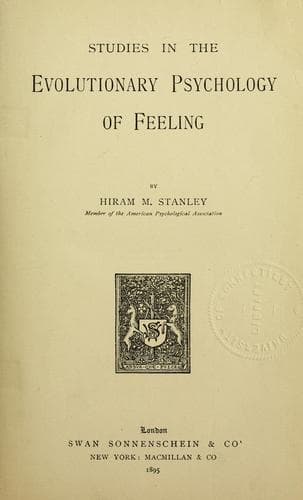
Studies in the Evolutionary Psychology of FeelingStanley, Hiram Miner
Philosophy
Studies in the Evolutionary Psychology of Feeling
Stanley, Hiram Miner
Emotions
To illustrate this psychological distinction between the sense of beauty
as inherent in style, and style as mere force and clearness, I instance
further only this sentence from Mr. W. D. Howell’s Italian sketches,
describing a side wheel steamer in motion: “The wheel of the steamer was
as usual chewing the sea, and finding it unpalatable, and making vain
efforts at expectoration.” This is the _ne plus ultra_ of a _pseudo_
literary style, of affected and strained literary art. An ugly metaphor,
forcible and clear enough, is relentlessly pursued to its ugliest
conclusion. Here is style in pin feathers, and we are glad to remember
that it was writ in callow youth. It brings “the mind by a bound to the
desired conception,” but this does not sanction it as fine art, for it
is utterly without taste and beauty.
I believe then from considering the previous examples—and they might be
indefinitely extended—that the main function of literary art is not
intelligibility, and that pleasure in style in its specific quality does
not arise out of economy of attention, but it is a direct communication
of pleasant æsthetic emotion artistically conveyed. Intelligibility is a
regulative by-law of art, but it is neither standard nor goal. Literary
art is then a compromise between intellectual and emotional motives,
between sense and sensibility. The natural choice and order of words for
easiest apprehension is rarely the artistic order, as every
_littérateur_ knows full well. It is, for example, simplest and clearest
to repeat the best and exact word, yet the literary artist avoids, and
rightly, the repetition of words in the same sentence or paragraph. Thus
also, while, as Mr. Spencer suggests, rhythm and euphony may often help
sense, yet I believe they as often distract from it. We often tend to
turn over in a very senseless way words and verses which please the ear.
As language is both an organ for meaning and for beauty, literary art,
like architectural, is always a compromise between utility and beauty,
that is, neither literature nor architecture are pure and perfectly
independent arts. However, it is possible that poetic license may, as
has already been done to some extent in English, ultimately develop a
pure poetic language, entirely distinct from the utilitarian product,
and bound by none of its practical rules; then and then only will
literature become a pure art.
Public-domain text, read in full here on John Shaqi.
Reviews
Reviews
No reviews yet
Be the first to share your thoughts on this work.
Elsewhere in the archive
Join the Discussion
Join the discussion
Sign in to leave a comment or review.
Sign InorCreate an account