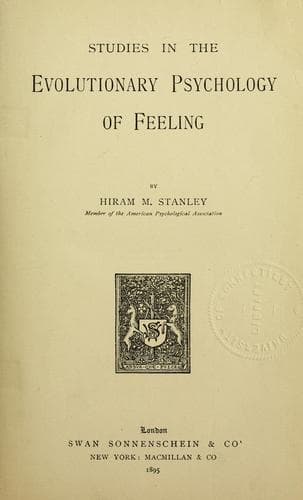
Studies in the Evolutionary Psychology of FeelingStanley, Hiram Miner
Philosophy
Studies in the Evolutionary Psychology of Feeling
Stanley, Hiram Miner
Emotions
expression which is and continues, by reason of its utility, as a
sign-language, visual, auditory, or otherwise, as gesture love-calls,
etc., may be termed pure expression as distinguished from incidental
expression, like blushing, pallor, etc., which exist, not for their
significance, though they are significant. Incidental expression
includes also the sphere of degraded action. Yet what seems mere
degraded action may be true expression, as beckoning, which is an
abridgement of the action of pulling one to oneself and of movement
towards oneself; but this motion of the hands exists, not for this end,
nor as survival, but merely as significant of a desire on the part of
the gesturer. In the higher ranges of life we well know the large place
played by pure expression as distinguished from incidental expression.
It is not necessary to suppose that pure expression consists merely in
“voluntary and consciously” employing “means of communication” (Darwin,
_Expression of the Emotions_, p. 256); thus, the scream of an infant is
equally pure expression, whether the infant employs it knowingly or not
as such, for screaming of the young has doubtless arisen and been
preserved in natural selection because of its utility as significant.
There is then, I think, a group of activities which are not merely
incidentally expressive, but originate and exist for expression as a
useful thing in the battle of life.
But we have not exhausted the principles of expression when we refer to
present or past serviceability as an action in general or to service as
expression. It is plain that in any activity prompted by any feeling
there comes at a certain high intensity a more or less pathologic
over-functioning of the organs concerned, with under-functioning of
others. Emotion as action stimulator in any high degree always enhances
some physiologic function to the depression of others. The blood, for
instance, is forcibly withdrawn from various parts to certain specially
active parts, and this withdrawal gives rise to an appearance which may
be termed a negative expression, as the pallor in fear. Certain other
phenomena connected with fear, as change of colour in the hair, cold
sweat, and trembling of the muscles, which are mentioned by Darwin as
unexplained, are probably due to this negative principle (_Expression of
the Emotions in Man and Animals_, New York, 1886, p. 350; but compare
pp. 81 and 308, where these disturbances are ascribed to direct action
of the nervous system. Darwin does not, however, distinctly state or
treat the principle we here mention as a distinct law). As the body is
an inter-related system of organs, stimulation to one organ means an
effect upon all, excitation of some, depression of others; thus to an
acute observer the whole body is symptomatic of every feeling, and,
indeed, of every consciousness. In the natural and normal course
emotion, to do its work most effectively, implies little or no marked
Public-domain text, read in full here on John Shaqi.
Reviews
Reviews
No reviews yet
Be the first to share your thoughts on this work.
Elsewhere in the archive
Join the Discussion
Join the discussion
Sign in to leave a comment or review.
Sign InorCreate an account