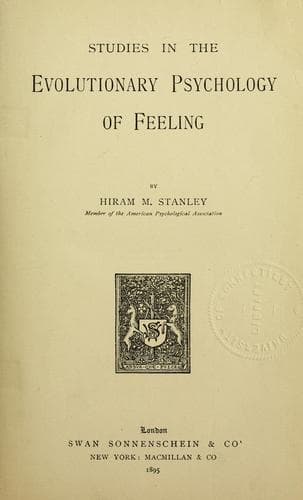
Studies in the Evolutionary Psychology of FeelingStanley, Hiram Miner
Philosophy
Studies in the Evolutionary Psychology of Feeling
Stanley, Hiram Miner
Emotions
tended rather to less than the required amount, than more.
The phenomena of diffusive expression, in the strict sense, are thus
rather late in appearance. The very lowest forms of life have no infancy
or play period, and from the first are directly active in the struggle
for existence. Yet the play period was certainly evolved through natural
selection as a fully educative and preparatory stage, wherein the
actions most demanded in actual life are unconsciously practised and a
general basis of reserve force is accumulated. Play activity is a living
on inherited energy and in the inherited modes: the kitten pouncing, the
horse prancing, etc. Play is then rather a mode of activity than a mode
of expression; it is expressive only in the way that all action is
expressive. Expression proper is only in those modes of action which are
carried on, whether consciously or unconsciously, by virtue of their
significance value. If everything which is expressive is called an
expression, we must include all the bodily actions and phenomena which
can in any wise be connected with consciousness. I use the term
diffusion in the narrow sense of spontaneous overflow of energy in
excess of that absolutely required for the advantageous action. I do not
refer to the general diffusion of emotional effect throughout the whole
organism, which always occurs by the very nature of organism. Thus the
pain from a pin-prick certainly modifies to some extent every cell in
the body; there is a direct wave of influence from the psychic
experience, and this is propagated throughout the whole organism by
reason of its essential interdependency of parts; it echoes and
re-echoes throughout the whole. The physiological result is then in
simplest cases extremely complicated. However, this mere general fact of
diffusion is a biological truism, and does not explain any expression,
but simply asserts that every feeling, by virtue of its physical basis,
affects the organism as a whole. Emotion issues specially in motor
activities because its origin was as stimulant to necessary action, but
this action involved internal organs, especially the circulatory and
respiratory, and indirectly the whole body in every part. The
explanation of an expression must always be in tracing back to the
original serviceable actions with their demands on special subsidiary
organs, and their depression of certain related organs, and not in
reference to the general law of diffusion, which is but another term for
the essential continuity of the organism. A useful principle of
expression must not merely say that there is by the nature of organism a
general bodily result from every emotion, but it must explain the
particular expressions.
Public-domain text, read in full here on John Shaqi.
Reviews
Reviews
No reviews yet
Be the first to share your thoughts on this work.
Elsewhere in the archive
Join the Discussion
Join the discussion
Sign in to leave a comment or review.
Sign InorCreate an account