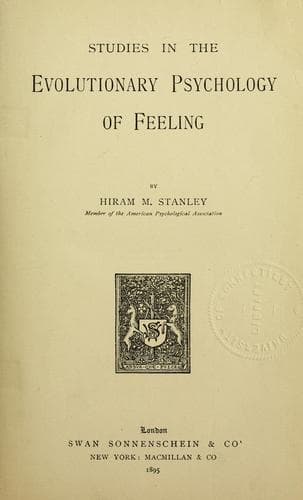
Studies in the Evolutionary Psychology of FeelingStanley, Hiram Miner
Philosophy
Studies in the Evolutionary Psychology of Feeling
Stanley, Hiram Miner
Emotions
Darwin makes antithesis a principle of expression. Thus the expression
of affection in the dog or cat toward its master cannot, says Darwin, be
traced in any wise to serviceability, and we must seek its explanation
merely as unconsciously and instinctively assumed as directly contrary
to the serviceable hostile expressions. A dog’s expression of anger is,
or has been, directly serviceable action, but the expressions of
affectionate pleasure seem never to have had such an origin, but to have
arisen merely as antithetic to the former, and so establishing the
utmost distinctness of impression. To convey most clearly a motion of
its friendliness the dog naturally assumes those attitudes which are
most diverse from its expression of hostility. Their serviceability as
expressions is best attained by being completely antithetical, and the
more antithetical the better under natural selection. However, if this
be the case, antithesis scarcely deserves, it seems to me, the name of a
principle of expression, but it merely denominates the fact that
opposite emotions in the struggle for existence tend to exhibit
themselves in opposite ways as similar emotions in similar ways; but we
need neither antithesis nor similarity as a principle. I believe that
serviceability past or present either as direct action or as expression
is the prime _impetus_ of what we term the expression of the emotions,
and I confess I do not see much force in Darwin’s Chapter on Antithesis.
If, however, opposition has a meaning for life, as Darwin seems to
imply, then does not the expression come under the law of
serviceability? If there is any opposition in expression, I should
explain this in general by utility rather than by antithesis _per se_.
Thus take the gestures instanced by Darwin (_ibid._, p. 65), of pushing
away with the hand when telling one to go away, and of pulling toward
when telling one to come; these gestures are, indeed, antithetic, but
their explanation does not lie in the fact of the antithesis, but in the
fact of the past serviceable habit, by which individuals disliked or
liked were repelled or attracted. In the present instance the person
motioned to may be far beyond the reach of the arms, but still the
gesture may be more than mere useless survival, for it acts as emphasis
of the vocal expression, and has its influence there.
Darwin for some reason constantly ignores the serviceability of
expression as such—not so much as a fact, but as a principle—and hence
its relation to natural selection, whereby he involves himself in
needless difficulties. If an expression is of use, why should it not
arise through natural selection as well as a limb, a wing, or an eye?
Like other functions, expression may be incidental or may adapt
variations attained originally for other ends, but in the case of the
voice, at least, we have an original organ of expression as instrument
of intercommunication.
Public-domain text, read in full here on John Shaqi.
Reviews
Reviews
No reviews yet
Be the first to share your thoughts on this work.
Elsewhere in the archive
Join the Discussion
Join the discussion
Sign in to leave a comment or review.
Sign InorCreate an account