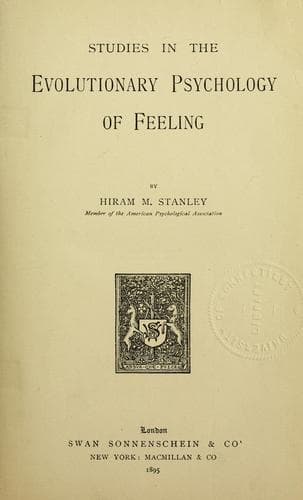
Studies in the Evolutionary Psychology of FeelingStanley, Hiram Miner
Philosophy
Studies in the Evolutionary Psychology of Feeling
Stanley, Hiram Miner
Emotions
With reference to the wagging of the tail in the dog, this is far from
being an expression of affection alone. I have already mentioned the
case of the setter where the movement of the tail is largely due to
diffusion of superfluous energy, analogous to nervous habits like pacing
the floor or biting the nails in human beings. With some dogs at least,
as I have noticed in my own St. Bernard, the tail is switched slowly
back and forth when approaching another dog with hostile intent. We have
not as yet a sufficient number of facts at hand with reference to the
history of the dog to pronounce the tail wagging as originating by
virtue of its use as expression. And what is the _rationale_ of the
origin of the tail in the dog and cat, and for what reason has it been
perpetuated? Is it a prehensile survival—which has been taken advantage
of in the breeding of the pug—or is it a sexual characteristic, or did
it originate to perform some directly advantageous action, as the tail
of the cow and horse, or did it come into being as an organ of
expression? Is the tail-wagging recognised by animals themselves as an
expression as it is by man? These are questions on which we must have
more data than we now possess in order to make any sufficient answers.
Again, the rise of the barking by dogs under domestication is another
problem on which little can be said with certainty for lack of data.
Darwin’s remark that it may arise by imitation of the loquacity of man
seems to me ludicrously inadequate, and there seems no element of
imitation in the noise produced. Domesticated animals in general tend to
use the vocal organs for louder sounds than when in the wild state, for
with wild animals the value of a loud noise as expression in any way is
largely counterbalanced by its betraying presence to enemies. When
natural enemies of the dog are driven out by man there will be a
tendency toward a larger use of the vocal organs, both with reference to
companion dogs and also to man. The particular sound, the bark, is
determined by the nature of the whole vocal apparatus. The bark was, no
doubt, originally to frighten aggressors, as I have often seen a large
dog frighten a small dog from a piece of meat by a sudden resounding
bark. Gradually attained as a mode of terrifying his competitive
associates and certain game which it follows under domestication, and so
preserved and developed by natural selection, the tendency is also
powerfully strengthened by artificial selection, the best barker, other
things being equal, being chosen for breeding by man. When the bark has
become a common and habitual practice, it becomes a vent for superfluous
energy developed by joy and other emotions. Like snarling or grinning,
it is also a play form, and thus becomes denotative of joy by
association. To impress one’s friendliness or hostility upon others, to
appease or terrify, are the two main ends of expression with both man
Public-domain text, read in full here on John Shaqi.
Reviews
Reviews
No reviews yet
Be the first to share your thoughts on this work.
Elsewhere in the archive
Join the Discussion
Join the discussion
Sign in to leave a comment or review.
Sign InorCreate an account