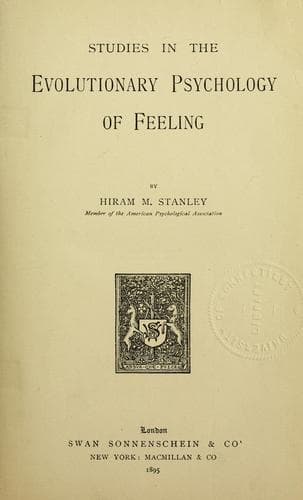
Studies in the Evolutionary Psychology of FeelingStanley, Hiram Miner
Philosophy
Studies in the Evolutionary Psychology of Feeling
Stanley, Hiram Miner
Emotions
The great relation of pursuer and pursued is constantly mimicked among
animals with interchanging of parts. So also among children the
commonest plays are those of fleeing and chasing, as tag, hare and
hound, hide and seek, etc., the fundamental elements of life being
re-enacted under the superfluous energy which tends to flow most easily
into the oldest and most habitual channels. Thus play has a high
historic psychic importance. To attack and to run away are the most
necessary and essential of life activities, and play has a certain
pedagogic and preparative value, and has thereby been sanctioned by
natural selection, for we see that in the evolution of life the tendency
has constantly been to lengthen the play period. Among the lowest
animals the individual at birth is immediately thrown into the struggle
for existence and must battle for itself; there is no play time for it,
but at once it enters upon direct life struggle; but in higher life
there is a period of spontaneous free dramatic activity.
But not only is anger and fear shammed as a prominent and primitive
play, but it is most common to stimulate to real anger or fear, and then
in glee to show the inadequacy of the occasion to the victim. Every one
has observed how frequently young animals play by teasing and scaring
each other. The tricks of boys and practical jokes of men both point to
the deep inbred power of anger and fear in life, and are at the same
time symptomatic of their decline in power as dominant life factors. All
children delight in scaring one another on pretence, in seeing the real
expression and feeling themselves the moving powers in bringing it
about. This satisfaction, which is aboriginal, which is the reflex of
the original pleasure sanction when power to scare others for one’s own
benefit was being evolved in life, makes a large part of the enjoyment
of such action. A large part of play-pleasure must, indeed, be set down
to reflex of the earliest hard-earned pleasure experience; but a large
part is also due to the thrill of excitement and the delight in activity
_per se_. Later forms of plays are largely due to pure imitative
propensity, though often helped by reversal tendencies.
Public-domain text, read in full here on John Shaqi.
Reviews
Reviews
No reviews yet
Be the first to share your thoughts on this work.
Elsewhere in the archive
Join the Discussion
Join the discussion
Sign in to leave a comment or review.
Sign InorCreate an account