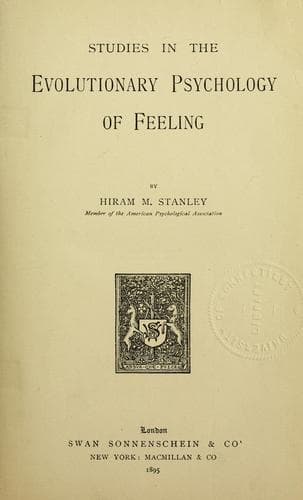
Studies in the Evolutionary Psychology of FeelingStanley, Hiram Miner
Philosophy
Studies in the Evolutionary Psychology of Feeling
Stanley, Hiram Miner
Emotions
We have far outgrown the sensation-cognition psychic stage, and speaking
of psychic history in biologic terms, it belongs to the early palæozoic.
We have yet to formulate the succession of psychic ages, in each of
which some distinct psychic power attains dominancy, and produces minds
as diverse from ours as the organisms of past ages are different from
our own bodies. As already pointed out, it is an extremely difficult
problem to realize by subjective method these ancient types. A mere
general sensation is a very rare phenomenon in our ordinary
consciousness, and even special sensations rarely occur in pure form. To
realize what sensation of heat is for a simple consciousness, we must
strip our minds bare of most of their furnishings, for all our
sensations of heat are interpreted with reference to visual and tactual
objects which must be non-existent for early consciousness. Sensation
for us is a complex of sensations _plus_ perceptions and other cognitive
and emotional elements which lie beyond early mind, but which by an
inevitable automorphism we interpret into early forms. This automorphism
with the child is complete, and is never perfectly effaced even in the
most accomplished psychologist. A life of simple feeling, or of this
_plus_ simple sensation is most difficult of realization; still we may
have reason to believe that the psychic life of a low type consists
wholly in repeated pains and pleasures occasionally rising so high that
consciousness reaches to a vague general sensation, or rarely to a
thrill of heat, or sense of hunger or pressure. Of course, in all cases
we assume will-activity.
And we have to emphasize this again, that all sensation, like all pain,
while always from objects is never of objects. The objective description
here, as usual, does not give the inner state. Our automorphic tendency
leads us inevitably to regard the order in which we perceive the
organism to be effected by external objects to be its received order.
But a little reflection always convinces us that this is in the nature
of the case an erroneous procedure, that what happens within
consciousness is not primarily any cognition of a world of objects, nor
an apprehension of them in any form. Sensation, while objective by
virtue of being cognition, is not in any way a realization of object,
but is objective only toward the dynamic within the individual organism,
and is not apprehension of static wholes of any kind. It is an
objectifying to force, not to things, and this in the modes of
physiological affection. It is not appreciation of a something, but of a
somehow.
Public-domain text, read in full here on John Shaqi.
Reviews
Reviews
No reviews yet
Be the first to share your thoughts on this work.
Join the Discussion
Join the discussion
Sign in to leave a comment or review.
Sign InorCreate an account