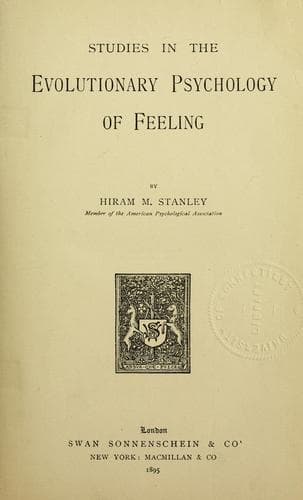
Studies in the Evolutionary Psychology of FeelingStanley, Hiram Miner
Philosophy
Studies in the Evolutionary Psychology of Feeling
Stanley, Hiram Miner
Emotions
In the earliest stage of mind, as has been before noticed, all manner of
material causes rouse nought more than a pure feeling mode; heat,
pressure, electricity, sound, light, nutriment or its absence, if they
attain to waken the function of consciousness, accomplish no more than
pure feeling as bare pain and pleasure. It is, of course, natural to
conceive that from the first consciousness, responds objectively in
sensation in as many modes as organism is moved by external and internal
forces; but a multiform sense origin of consciousness is not borne out
by the general tendency and law of evolution, nor yet by such special
indications in consciousness as we are able to observe. When a very
young infant seems to reach pleasurably to warmth, if we are correct in
positing consciousness at all, it is still very unlikely that there is
sense of warmth, but the state is probably pure pleasure; and if there
is sense of warmth, it did not give the pleasure, but the reverse. We
believe likewise that it is probable that a consciousness response to
nutriment is, at first, mere pleasure, and only, secondarily, organic
sensation. Thus, warmth and nutriment effect, but only, at first, in the
one mode of pure feeling, and secondly, pure sensation as general
organic satisfaction. Lastly arises a differencing in consciousness for
the different bodily changes. And the multiformity of stimulus and
paucity of consciousness in modes while so very apparent in early mind
is yet always found in all grades of psychic life. The responsiveness of
consciousness is never perfected, and mind has a practically infinite
field for the acquirement of sensation, for appreciating what has never
affected consciousness, or which mind has felt or known only by some
general mode. The infant, no doubt, has many pains for which it has no
sensation values. These pains, perfectly pure and undifferentiated the
one from the other, have had their occasion in a variety of physical
changes. A native of the tropics, who on first touching ice says it
burns, has at first but a single sensation for very diverse physical
affections; but he soon attains an icy sensation, that ice feels not
burning, but stinging cold. Men, civilized and educated, often are
consciously affected by bodily changes of which they are wholly
incognizant, the psychosis being not specialized according to the mode
of change. In degraded states of consciousness, which come to all, there
often appears obscure feeling and sensation, which is a practically
single mode of answer to a very wide variety of physical excitation. In
realizing the variety of external objects and changes the mind proceeds
but slowly, each new form always at first in pure feeling. It is only as
something affects feeling and interest that we ever come to know it or
its manifestations in physiological change.
Public-domain text, read in full here on John Shaqi.
Reviews
Reviews
No reviews yet
Be the first to share your thoughts on this work.
Elsewhere in the archive
Join the Discussion
Join the discussion
Sign in to leave a comment or review.
Sign InorCreate an account