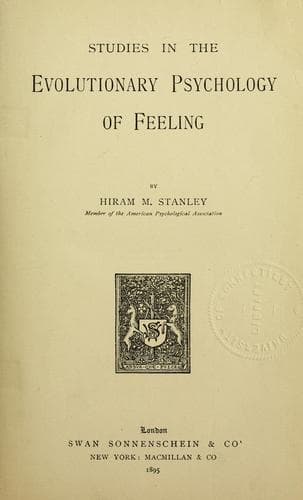
Studies in the Evolutionary Psychology of FeelingStanley, Hiram Miner
Philosophy
Studies in the Evolutionary Psychology of Feeling
Stanley, Hiram Miner
Emotions
The early phase of mind where consciousnesses are wholly un-unified from
within by any central or continuous consciousness, and whose solidarity
is wholly in an unconscious integration is so foreign to us who have
minds where experience of experience is continually in process, that it
is with the utmost difficulty we can in any wise conceive it. It is
evident that a very low organism may have consciousnesses, but no mind,
that is, no self-unifying whole of consciousnesses. It does not possess
a mind, but during its whole life it attains psychoses which are merely
_disjecta_ reached to help an immediate necessity of existence, and then
fading completely away. Each psychosis is achieved more easily than the
former by reason of the former, though there is no consciousness of
connection with it. The increment and qualifying of a given experience
by past experience is not reached by it. Some differentiation is
attained under pressure of struggle for existence, and experience is
constituted, but is wholly unknowing of itself and in no wise
self-formative.
We have now, however, to consider the problem, how experience came to
itself, and how and why representation and emotion should arise in the
struggle of existence.
At the first, as we have seen, organisms responded in conscious form
only in pleasure and pain, and this only when the actual damage or
benefit to the individual was very considerable. When the hurt was
critical, then only was pain accomplished as a function to secure
self-preservative action, but gradually through survival of the fittest
the greater susceptibility was attained, so that minor lesions are felt
in pain terms, and some general sensing and objectifying lead to some
differentiation in adjustment. The external parts of the body become
specially sensitive, and ciliate extensions are formed. Injury to these
results in pain and consequent reactions, and in this wise by injury to
a small part great harm to the organism as a whole is prevented. The low
forms of life are thus enabled to avoid the hurtful before they meet it
in full annihilatory force. These practically anticipatory
reactions—though there is no real anticipation in consciousness, no real
experience of experience—I term the method of incipiency. Pain reactions
are thus reached with less and less actual harm until the very slightest
injury to a minute tentacle will suffice to awaken pain.
Public-domain text, read in full here on John Shaqi.
Reviews
Reviews
No reviews yet
Be the first to share your thoughts on this work.
Elsewhere in the archive
Join the Discussion
Join the discussion
Sign in to leave a comment or review.
Sign InorCreate an account