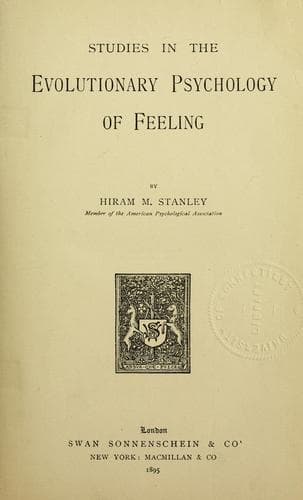
Studies in the Evolutionary Psychology of FeelingStanley, Hiram Miner
Philosophy
Studies in the Evolutionary Psychology of Feeling
Stanley, Hiram Miner
Emotions
Revival often occurs in mind without sense of revival, and so is not
true representation. In disordered states of the nerves we frequently
see objects which have no real existence, the states are revival states
as objectively interpreted, yet there being no sense of revival they
stand in consciousness for real presentations. When I see a person
sitting in a chair but afterwards find that no one was there, I
characterize the state very naturally as a mere imagination, a
representation; yet in fact it was in subjective quality a presentation.
We are not to psychologically classify, as is too often done, psychical
states according to presence or absence of object, but as to sense of
presence or absence of object. It is only as consciousness takes note
with reference to object that there is differentiation in consciousness
to make presentation and representation.
We must consider it probable that the earliest revivals by consciousness
were solely of the unconscious sort, or, objectively speaking, were
hallucinatory. A sense order is formed, which attends to a series of
objective realities; let now, on some occasion, one of these objects
drop out, yet there will be attaining of some sense of it as though it
were present, and the proper reaction will be carried out. The mind gets
its early revivals without sense of revival. They have presentative
force, and are sensings of objective reality though there is no
objective reality there at the time to sense.
These early simple revivals, which are all hallucinatory, perform an
important function. They are practically anticipatory, in that the
reaction is secured before the actual presence of the reality. Thus they
save an actual bodily experience, though the mental is quite real, yet
fainter than actual object would give. Thus with an enemy an animal will
revive, upon slight indirect sensation, previous experiences, and it
will have in ideal form, _i.e._, without the objective reality, a very
real experience with what is to it real enemy, thus escaping before full
advent of enemy. When a shadow alarms a low organism—and even very low
organisms seem to react to shadows—there is no actual harm done to its
members as would happen with a concrete body, and hence there is no
direct pain. The shadow is yet taken for real body, and revival pains
and revival sensations are attained with this, and there is consequent
activity. Shadow does not appear as sign of enemy, but in itself a
dangerous reality, so that anticipatory reaction is gained without
actual representation. In most cases in low organisms what we take for
fear or other emotion is probably no more than revival of the type of
which this shadow experience is an example. What is actually unreal,
being only revival, is taken for the real, and is acted on accordingly,
and in most cases this action is of service as anticipatory. When the
organism discovers the shadow to be but shadow, a something, not the
Public-domain text, read in full here on John Shaqi.
Reviews
Reviews
No reviews yet
Be the first to share your thoughts on this work.
Elsewhere in the archive
Join the Discussion
Join the discussion
Sign in to leave a comment or review.
Sign InorCreate an account