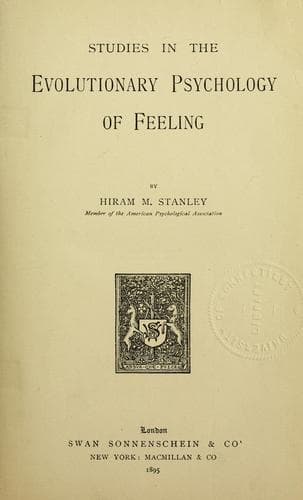
Studies in the Evolutionary Psychology of FeelingStanley, Hiram Miner
Philosophy
Studies in the Evolutionary Psychology of Feeling
Stanley, Hiram Miner
Emotions
Emotion is an arousing and energizing. It is perturbation, disturbance,
agitation, excitement. It is a throwing open the throttle and putting on
a full head of steam. The whole organism quivers with the sudden inflow
of force and life, is quickened to its highest pressure. In all higher
psychic life it is a driving force of the utmost importance. However,
the trend of evolution is in the direction of economy, and with the
highest forms of consciousness emotion accomplishes its work even before
arriving at agitation intensity. Feeling of the emotion type, that is,
representative, is always at first a rather intense perturbation. Fear,
for example, is with the lower minds always fright; with higher minds it
often appears as dread. I stand on the railway track when a train is
approaching, and a slight fear enables me to take the self-conservative
action of stepping from the track; but with my dog, in similar
circumstances, I judge by his hasty jump and general expression that his
fear is always more intense and more generally disturbing. Emotion being
a force which quickly tends to exhaustion, it is obvious that those
animals will, _ceteris paribus_, have the advantage which react with the
least expenditure. Thus the tendency of evolution is away from intense
emotionalism.
In this emotion conforms to a general law. The earliest occurrences of
any given form of psychosis are with strenuousness and with exaltation
and excitement of the organism. We speak of fits of anger and gusts of
passion, but for early consciousness we might also justly speak of fits
of seeing and hearing. Common vision of external objects is for lower
consciousness as rarely attained, and requires as much of force as
beatific vision of seer and poet in the human mind. The new psychosis is
but momentary, and implies high tension and great friction, but progress
is toward continuity and ease of working. Emotion is in human life a
tolerably constant element, like perception with whose representative
side it is correlated, and within certain ranges it rises because of the
force of heredity with apparent spontaneity.
We remark that the social significance of emotion is embodied in the
word _treat_, as _treat_ kindly, badly, etc. Our _treatment_ of each
other always means activities inspired by some emotion.
Public-domain text, read in full here on John Shaqi.
Reviews
Reviews
No reviews yet
Be the first to share your thoughts on this work.
Elsewhere in the archive
Join the Discussion
Join the discussion
Sign in to leave a comment or review.
Sign InorCreate an account