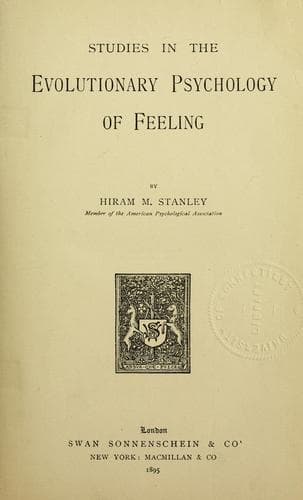
Studies in the Evolutionary Psychology of FeelingStanley, Hiram Miner
Philosophy
Studies in the Evolutionary Psychology of Feeling
Stanley, Hiram Miner
Emotions
It may be considered as plausible that if the first feeling was pain,
the first emotion was also of the pain character. The first
representation of an object as painful induced that reaction of mind
which we term an emotion, and the painful emotion we call fear. That the
first emotion to appear was fear, as fright, seems likely when we
consider that the general alertness and defensiveness imperatively
required in the struggle for existence is thereby most immediately and
simply attained. The acquirement of the power to become frightened is
plainly a most important requisite for self-preservation, and thus is
indicated as a very early factor in conscious life. An animal being
devoured by another may merely suffer pain without any perception of the
object as pain-giving and to give pain; but if it attains this
perception, there may be added to the stimulus of simple pain that of
fright. The direct actual pain may be but small, and so inducing but
feeble reaction, as when some less sensitive portion is being injured;
but if there occurs a vivid representation of potential pain, fright
happens and stimulates most strenuous endeavours, and so rids the animal
both of the immediately and the prospectively painful. Thus emotion acts
as a complement to simple feeling, and also secures practically
anticipatory reaction. Animals which must receive actual injury before
experiencing pain are clearly inferior to those which experience
emotion-pain before the injury is actually received. Other things being
equal, the most easily frightened have, in the midst of many destructive
agents, the best chance of survival and of perpetuating their kind.
-----
Footnote B:
Originally appeared in part in _Philosophical Review_, i. pp. 241-256.
-----
It is unnecessary to dwell at length on child life and savage life as
illustrating the primitive quality and function of fear. The earliest
experiences of the child with things are lessons of fear. The burnt
child dreads the fire, and thus is enabled to preserve himself from
threatened injury. Fear is a primary and most important motive to action
in a very wide range of the lower mental life. Those who have observed
animals and man in a state of nature are always greatly impressed with
the constant and large part which this emotion plays in their
consciousness. With the timid and weaker species, like the rabbit and
squirrel, it is likely that a majority of their cognitions prompt to
fear or are prompted by fear, and with some persecuted races of savages
the same may be said.
The necessity and value of anticipatory reaction being acknowledged in
the struggle of existence, we plainly see a primitive motive thereto in
fear, and the earliest emotional life which we can clearly interpret
likewise seems to be fear.
Public-domain text, read in full here on John Shaqi.
Reviews
Reviews
No reviews yet
Be the first to share your thoughts on this work.
Elsewhere in the archive
Join the Discussion
Join the discussion
Sign in to leave a comment or review.
Sign InorCreate an account