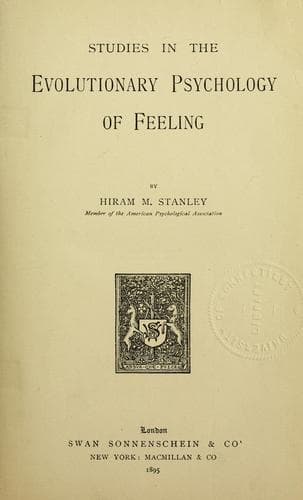
Studies in the Evolutionary Psychology of FeelingStanley, Hiram Miner
Philosophy
Studies in the Evolutionary Psychology of Feeling
Stanley, Hiram Miner
Emotions
The original pain-impelled cognition brings in the painful emotion,
primitive fear. And as knowledge has brought in fear, so fear reacts on
knowledge, and fearfulness incites to knowing even when the pain from
object ceases. Thus before any actual experience of an object it may be
known and felt about. Thus that habit of objectivity is formed, of
alertness, of a fearful sensing and perceiving, which is noticeable in
many animals. A cognitive-emotive, emotive-cognitive life is formed and
developed. It is a tremendous stride onward to be able through fearful
cognition to wholly pre-perceive and anticipate the injurious, instead
of having to suffer it in part before being enabled to get away.
Now primitive fear and all primitive emotion plainly utilizes the past
experience as interpreting the future; emotion is about a known potency.
Yet it is often stated that emotion is but a summation of revivals of
past experience. Having often been burnt by fires that I have
coincidently been looking at, it sometimes happens that I see a fire
which has not yet harmed me, but still the mere sight affects me with
what I call the emotion of fear, which, in closest analysis, means
merely the revival of the burning pains associated with this seeing in
the past. “I am afraid” equals “I re-experience the pains of burning” by
suggestion. Pains faintly re-occurring constitute the painful fear.
There is in this mass of re-awakenings no real cognition of experience
and no feeling about it as such, no psychosis _at_ the experienceable.
And it is certainly true that when a fixed sequence of experiences tend
to recur together, there will follow upon the cognition, revival waves
of pain before any actual increase of pain is really inflicted in the
given case. These waves stand for, and are the echoes of, the former
real pain sequences of cognition. Thus the perception of a great mass of
ice will often cause a shivery feeling, a painful sensation is revived
as correlated with former cognition experiences. Even the image or
representation, the purely and consciously ideal cognition, may bring in
painful feeling, as when I say, “It makes me shiver to think of it.”
Here the painful sensation-bringing idea is cognized as such, but the
representation here is the occasion of a direct painful sensation, and
evidently does not imply fear or other emotion.
Public-domain text, read in full here on John Shaqi.
Reviews
Reviews
No reviews yet
Be the first to share your thoughts on this work.
Elsewhere in the archive
Join the Discussion
Join the discussion
Sign in to leave a comment or review.
Sign InorCreate an account