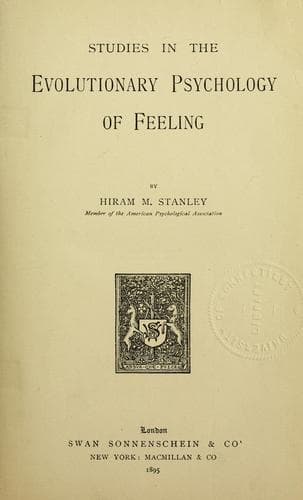
Studies in the Evolutionary Psychology of FeelingStanley, Hiram Miner
Philosophy
Studies in the Evolutionary Psychology of Feeling
Stanley, Hiram Miner
Emotions
Further, if the pain in fear were wholly of revival nature, not only
should we expect fear of different sensations to be correspondingly
distinct, but we should also expect the pain in fear to never exceed in
amount and intensity the pain feared as indicated by measure of past
experience. But we know that our fears are often much more painful than
pain feared and than our experience of past pain. The pang of fear, of
sudden fright, is often more acute and intense than any direct pain we
have ever experienced. The terrible convulsions of fear which we see in
the insane give evidence of pain which could not have been reflection
from direct experience. That excessive and sudden fear which turns men’s
hair gray in a few hours and transforms their whole physical system is
plainly not any revival from the individual’s past experience. As
revealed by its effects it is often, perhaps, greater than the whole
amount of pain they have ever suffered. Where, in the direct-experience
form, pain is greater in the fear than the real pain suffered, we
express the fact by the common phrase, “more scared than hurt.” In all
such cases the pain in fear is not the revival of past experiences of
the object feared.
Fear is, in the main, the peculiar pain coming from consciousness of
experienceable pain, but in general in all complex consciousness it is
marked by dissolution and weakening of mental force. There is a
shrinking of will, and a clouding of cognition, a general unsettling of
all mental elements, a commotion or agitation which destroys the organic
_consensus_ of consciousness. But any excessive functioning of some
element in consciousness, of emotion life, as fear, or of any other
form, is unbalancing and detracts from normal activity of the whole.
Fear, however, in its normal measure and form arose and was developed as
a desirable stimulant; where it becomes paralyzing in its force, it is
pathological in quality. Also where fear is pathologically intense it
tends to disappear in sensation feared. Cognition becomes so weakened
that sense of representativeness is lost, the thing feared is no longer
brought before the mind in its potential quality, but is immediately
apprehended as present in its influence—though really objectively
absent—hallucination is produced, and fear naturally reverts to its
earliest and direct form in immediate experience. As cognition is still
further weakened the sense of object as giving pain is lost and fear in
any form entirely disappears. The pain is not felt which before was
feared to be felt. Fear thus in the general order of its disappearance
repeats the order of its appearance and growth.
Public-domain text, read in full here on John Shaqi.
Reviews
Reviews
No reviews yet
Be the first to share your thoughts on this work.
Elsewhere in the archive
Join the Discussion
Join the discussion
Sign in to leave a comment or review.
Sign InorCreate an account