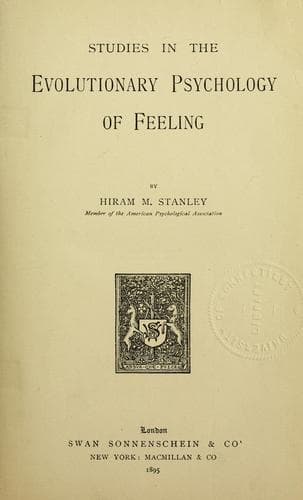
Studies in the Evolutionary Psychology of FeelingStanley, Hiram Miner
Philosophy
Studies in the Evolutionary Psychology of Feeling
Stanley, Hiram Miner
Emotions
The qualitative relation of the pain of fear to the pain feared varies
greatly with the evolution of mind. Fear-pain could not have originated
as a substitutionary function for the real pain except by being at the
first somewhat less in quality than the pain to be endured, otherwise
there would be no economy in the function. The progress of this function
is to secure at less and less expense of fear-pain the suitable
reaction. The function of fear being to escape a greater direct pain by
a less indirect one, the progress of the function is in diminishing the
amount of fear-pain for required effectiveness. The small original gain
in the ratio is increased by small increments till in the highest minds
proportion of fear-pain to pain feared might be represented by
1⁄∞. The pain in the usual fear which commonly induces me to step from
the track before an approaching train, or which enables me after
reading some advice on the subject to take precautions against the
cholera, is evidently in infinitesimal relation to the pain feared.
When fear is unsuccessful, as in anticipating a visit to the dentist,
we, of course, suffer a double pain, both the fear-pain and the
pain feared.
Often we must observe that the pain of fear is equal to or greater than
the experience feared, and we have to ask how this disadvantageous
excess could have been evolved. Often the pain of anticipation turns out
to be far greater than the pain anticipated. However, a little
reflection assures us that the excess of fear in many cases is only in
appearance. We do not fear too much upon the judgment we have formed as
to the coming pain, but we have by error of judgment assigned too much
value to the pain. When a person being initiated into a secret society
trembles with fear at being told to jump from a precipice, when he
really is to jump but a few feet downward, his fear was perfectly just
according to his judgment. If his belief is perfectly assured, the
mortal fear will make him offer the most strenuous resistance and most
likely secure his release from the ordeal. In all such cases the feeling
is right enough, but the estimate of future experience is inaccurate.
When an animal is terrified at its own shadow the fear is justly
proportioned to the estimate of danger, which, however, happens to be
erroneous. In the evolution of mind in the struggle for existence, more
and more accurate calculations of possible injury are attained, and fear
becomes more and more rational. Educated men fear only what is worthy of
fear; they fear many things that lower minds do not, and do not fear
many things they do. The true excess of fear is where we fear against
judgment, as when, knowing the safety of travel by rail, I am yet
constantly in fear while aboard a railway train. When I still continue
to fear, though I know the fear to be groundless, this is a true
hypertrophy of fear. We constantly observe those who are fearful and
timid against their own reason.
Public-domain text, read in full here on John Shaqi.
Reviews
Reviews
No reviews yet
Be the first to share your thoughts on this work.
Elsewhere in the archive
Join the Discussion
Join the discussion
Sign in to leave a comment or review.
Sign InorCreate an account