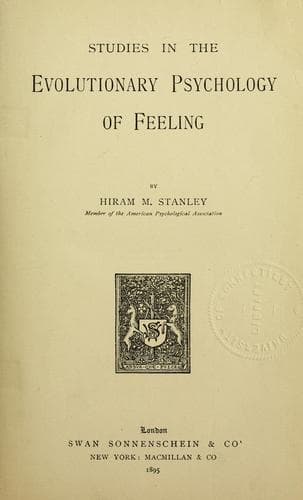
Studies in the Evolutionary Psychology of FeelingStanley, Hiram Miner
Philosophy
Studies in the Evolutionary Psychology of Feeling
Stanley, Hiram Miner
Emotions
Of course the whole value of sense of one’s own superior power is in
fear, thereby securing the contingency of the painful event, but sense
of contingency upon one’s own efforts no doubt first occurs at a
considerably advanced stage, much beyond that of simple fear.
Primitively mind regards events as being, or about to be, with no sense
either of their certainty or uncertainty. Early mind cannot appreciate
certainty, for it knows not uncertainty, it has not yet accomplished the
prevision to which certainty and uncertainty may attach; it cannot say,
“I fear this will happen,” or “I fear that will not happen,” but only “I
fear or do not fear the thing happening, the event coming.” The world of
the earliest psychical life is simply factual, and the fears are simple
and wholly undifferentiated. Fear certainly antedates the perception of
contingency and of one’s own agency in producing contingency. Even in
the ordinary fears in human consciousness sense of personal power in
relation to pain-giver is actually subsequent to the fear phenomenon and
reacts upon it, but is not constitutive of it in its first impulse.
Fear is first graduated by the increasing discrimination as to the
amount of pain and injury to be inflicted, and later it is graduated by
the sense of the painful event as more or less contingent, either in the
natural course of things, or as determined by the individual’s strength
in warding off impending evil. Taking chances and risks is learned, and
becomes often very advantageous. Fear is also greatly diminished and
modified by acquiring a sense of one’s individual power in overcoming or
resisting pain given. The rabbit, often chased by a clumsy dog,
evidently fears him less and less. Man, both by his increasing knowledge
of natural contingencies and by his increasing power over elemental and
animal pain-giving forces, fears less and less. The inevitable evil,
sure to come, and sure to overcome, is that which strikes intensest
fear, as we often see in criminals led to execution.
The discrimination between the animate and the inanimate also
differentiates fear. When this distinction is fully achieved, the
attitude of mind toward each in fear is plainly distinct. The thing,
perceived as having psychic powers, and capable of purposive evil and
self-directive of its movements, awakens thereby a complex of feelings
which rapidly develops beyond our present powers of analysis to follow
them. For the present sketch of the early natural history of fear it is
sufficient merely to remark this differentiation as one of prime value
in the struggle for existence.
Public-domain text, read in full here on John Shaqi.
Reviews
Reviews
No reviews yet
Be the first to share your thoughts on this work.
Elsewhere in the archive
Join the Discussion
Join the discussion
Sign in to leave a comment or review.
Sign InorCreate an account